

10 Rude Customer Behaviors That Restaurant Servers Absolutely Hate

The restaurant industry is not one for the faint of heart. It requires long hours spent on your feet, late nights and nonexistent weekends, and more filched french fries that qualify as "dinner" than can be counted. It's also an extremely rewarding profession that connects you with many different kinds of people, enhances your social skills, and helps establish a camaraderie among your coworkers. For more than a decade, I've had experience in various restaurants as a hostess, server, bartender, and manager, which means I've endured the nitty gritty when it comes to customer behavior.
One major element that can make or break a shift when you're working as a server is the customer. From picky eaters who want every modification possible (or impossible) to huge groups, there's a lot to watch out for. If you don't want to be the customer everyone dreads seeing walk through the door, these are behaviors you'll never want to display.
Snapping fingers or whistling

Getting your server's attention in a loud or busy restaurant can be a tough task. If you're trying to track down someone to pay your bill since you're in a bit of a rush, it can be frustrating to see them chatting with another table and seemingly ignoring you. Something you could do is simply wave at them when they look up to get their attention and signal that you need their help. Something you should definitely not do, however, is snap your fingers or whistle.
Your server is not your servant, nor are they your dog. Sure, they might come over to your table, but they will not be pleased to see you. No person I have ever worked with in the service industry has ever taken kindly to snapping fingers or whistling. It's both demeaning and immediately puts you on a server's "bad guest" list. You are not the only table your serve is attending to; learn that sometimes you have to wait your turn.
Split checks on multiple cards
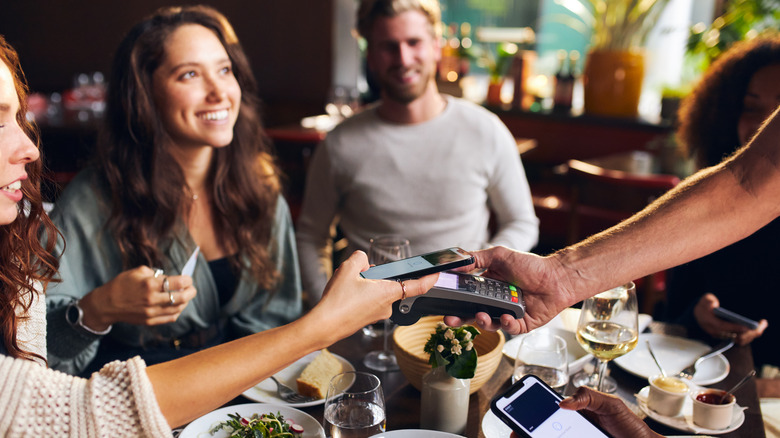
It's already a hassle organizing a big group to go out to dinner, especially with varying schedules, possible family commitments, and dietary preferences or needs. The planning of such an occasion is stressful. Another thing that happens to be stressful? Splitting a gigantic check based on individual orders across multiple cards.
No one wants to pay for more than they ate, especially if there's a major range between budgets. However, if the restaurant in which you're eating is slammed, your server is in the weeds, and you've just asked for split checks that require the server to stand around and complete each individual transaction, you're definitely not doing yourself any favors. Instead, designate one or a couple of people to take the check(s) and ask the rest of your party to send you the cost of their meals later. If you're dead-set on splitting checks, let your server know as soon as you sit down so they can prepare themselves accordingly, which allows for a much smoother transition for everyone.
Telling them you know the manager
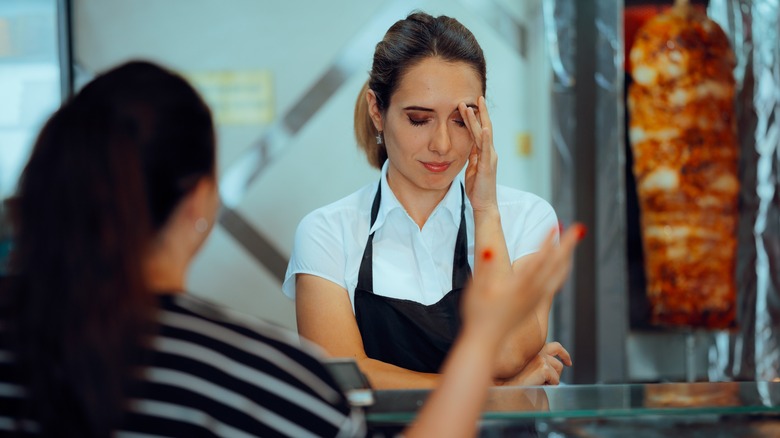
Oh, you know the manager? Well, what a shock, so do we! Unless you're letting your server know that you're BFFs with the manager because you want to say hello or have something to tell them that is of the utmost importance, this is an obvious power move that some customers think will get them above average service — because of the unspoken threat that you'll say something negative about them to their employer.
Telling servers that you're in with the manager isn't a guarantee you'll get great service — instead, it may mean that you'll receive a perfunctory, by-the-book dining experience so that you don't have anything to complain about. It reeks of entitlement and expecting preferential treatment. No, we will not ignore our other tables simply because you're hanging it over our head that you know the boss. It puts everyone in the restaurant — customers and staff — at a disadvantage when you try to pull this card.
Not tipping
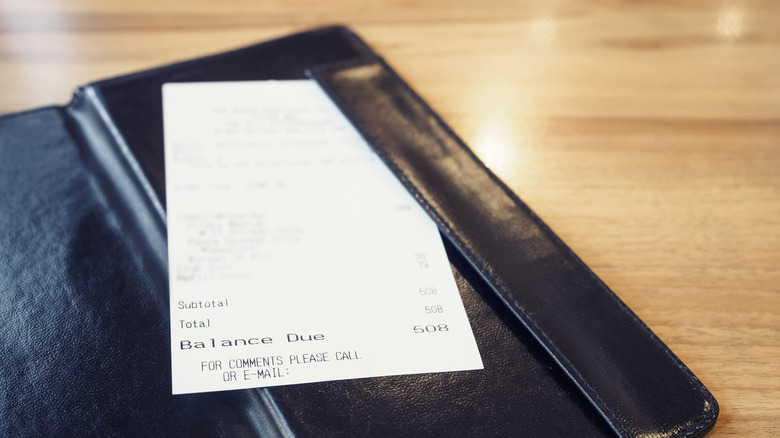
Not tipping? In this economy? Not a chance. Nothing says "rude customer" like not leaving a tip. Or worse, the "verbal tip," which is flowery compliments and exactly $0; no one can pay rent with that. Servers do not have a say in the prices of items on the menu, the cost of your glass of wine, or even the taxes. Servers across multiple states make as little as $2.13 an hour, which means many rely on tips to survive. Additionally, plenty of restaurants require servers to "tip out" the rest of the restaurant staff from their earnings. If you choose not to tip, then the server has actually paid a portion of their own money to do their own job of serving you. If someone came to your place of business and gave you a bill for the privilege of working, you probably wouldn't be too happy — neither are servers who get stiffed.
About 15% used to be the low end of the standard for sit-down restaurants, but, with inflation and the cost of living on the rise, many agree that 20% is the new norm. Not into tipping? Choose to eat at home, instead.
Dining and dashing
Dining and dashing isn't just a bad look: It's theft, plain and simple. Not only did you order food and drinks and take up a table and the time of your server, but then you decided to skip out on the bill. Maybe you did it for a thrill, or maybe you suddenly remembered you forgot any form of payment, but you up and left. Now a server is left to contend with the fact that a table they served ending up dining and dashing.
Some restaurants have a fund in place to account for customers who dine and dash, but many do not. Instead, they'll take it out of the restaurant's cash for the night — or, in the case of some reprehensible managers, even out of the pay of the server. Dining and dashing is beyond a rude behavior — it's criminal, and something that will get you banned from the establishment if they ever spot you trying to come in again.
Letting kids run wild
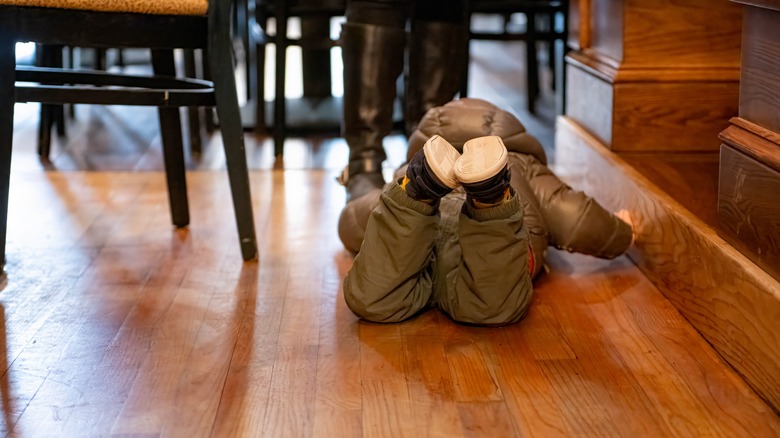
Most servers I know don't have any problem with kids coming into their restaurants. Whether they're coloring at the table, watching a show on an iPad, or simply nibbling something from the kid's menu, kids are great — accompanied with an adult or guardian, of course.
However, there have been more than a few occasions in any server's lifetime when parents have decided that going out to eat also means they get to take a break from parenting altogether. That means they're letting their kids run wild. Playing hide-and-seek, jumping out to scare other patrons, or screaming at the top of their lungs — some parents treat servers as de facto babysitters. Unless you're paying a whole extra wage for servers to look after your kiddos, that's gonna be a no.
Trying to weave around little munchkins when your hands are full with stacks of plates, teetering glasses, or precariously balanced dishes is a recipe for disaster. Not only can things break, but stuff can fall and hurt kids who aren't paying attention (and whose parents are absent, too). Keep your kid seated, order their food first, and try and engage with them to keep them from going feral.
Hitting on them
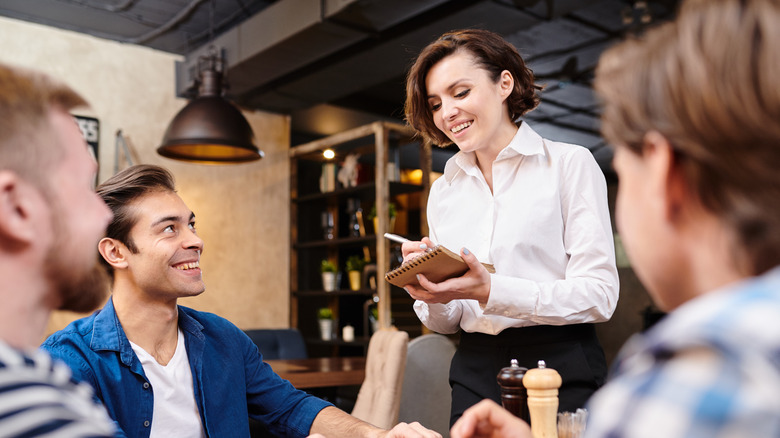
Servers earn their living by being nice, attentive, and friendly. They can be funny, congenial, and personable — it all depends on the server and their style. One thing a server is not looking for at their place of work is a date. Hitting on a server is creepy, weird, and a total imbalance of power. Servers are required to be polite and return to your table multiple times throughout your visit. When you use that as a reason to keep them trapped while you engage in unwanted advances, you've moved into rude customer territory.
As previously stated, many servers depend on tips for their livelihood, and customers who know this and use it to their advantage are just plain entitled. It can also make your server feel unsafe, especially if you're lingering trying to get their attention repeatedly. Leaving your number, flirting outright, or asking them out puts them in a very uncomfortable position. Plus, more often than not, customers who do this end up leaving bad tips because they feel the server hasn't been sufficiently flattered by their advances.
Using no manners

When you're going out to eat, no one is going to give you a hard time about having your elbows on the table, napkin etiquette, or chewing with your mouth open (although you may encounter the occasional side-eye). When saying rude customers are those that use no manners, that means the basics of common courtesy required to interact in society at large.
While a server is doing their job to provide a service, it's still always appreciated when guests say a simple "please" and "thank you." Treating your server like the human being that they are shouldn't be a surprising thing to say, but then you might be shocked by the number of customers the average server has encountered who demands rather than requests. Another element of manners is being aware of your surroundings; if you're standing near the hostess stand waiting to be seated, don't crowd the door. If your server approaches your table to introduce themselves and take your order, don't gape at them like you've suddenly lost the power of speech. Another egregious error? Staring at your phone instead of acknowledging their existence.
Leaving a mess

Some servers may bus their own tables, while other restaurants employ busboys for this duty. Either way, it's also good manners not to leave a mess. Dirty dishes and napkins are par for the course — it is a restaurant, after all — but disgusting concoctions of mixed condiments, the contents of your emptied-out purse, and even dirty diapers (yes, seriously) should definitely not be left behind for your server to clean up. You wouldn't want someone to leave your table at home covered in filth, so why should you do so when you're dining out?
For those who have young children, messy eating is pretty much bound to happen. What parent hasn't picked their baby up out of a high chair only to see a plethora of food mashed underneath? While no server expects you to get down on your hands and knees and sweep up the mess, it is appreciated when some effort is taken to put things back in order. A quick swipe with a wet wipe or a gathering of broken crayons goes a long way.
Lingering a long time

In the restaurant industry, there's a word known as "campers." Rather than the kind of people who love the great outdoors, campers at restaurants are the people at tables that like to linger long after they've paid their bill, blissfully unaware — or are aware and just rude about it — that their server needs to turn their table for the next set of guests. Servers have little tricks to try and subtly cue their guests that it's time to leave, like removing everything from the table except the people themselves. They will also come back multiple times to ensure there's nothing else they can get you, which is a polite way of urging you to leave if the restaurant is filling up and you're still rooted to your seat.
If a restaurant isn't busy, it might be okay to linger for a little while, but if the place is hopping, you don't want to be the table that decides to set up residence. One to one-and-a-half hours is standard, depending on the type of restaurant and number of people in your group. You shouldn't feel rushed, but you should know when it's time to go, too. Oh, and don't be one of those people who shows up five minutes before closing and decides to stay forever. That's a double strike against you.