

What's That Red Stuff Coming Out Of Your Burger? Science Has The Answer
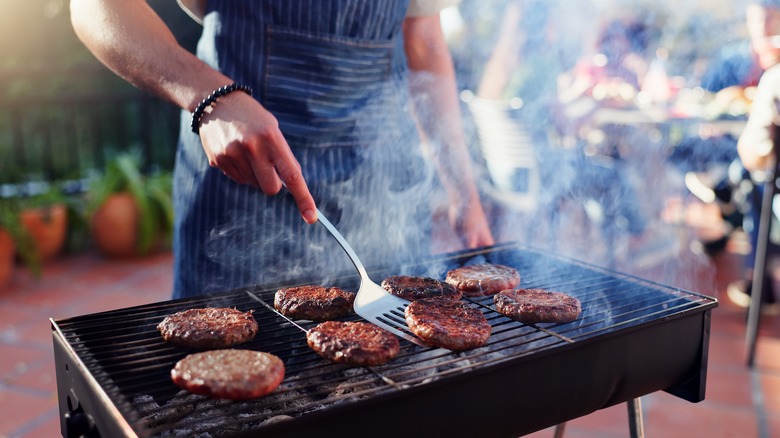
Cut into a medium-rare burger, and you'll often see a rush of red liquid pooling on the plate. It looks like blood to the common layperson, which is why it makes many of us a little uneasy (or queasy). But despite how convincing it appears, that good news is that red juice isn't actually blood at all. Science has a much more soothing explanation: it's myoglobin. Myoglobin is a protein found in muscle tissue, and its job is to store and transport oxygen within muscle cells. It's the same reason why Ahi tuna is naturally a deep burgundy red. It's often confused with hemoglobin, because they're both oxygen-binding proteins that give our muscles and blood the color red.
What do all these bloody terms have to do with your burger? Well, when an animal is slaughtered, the very next process is to drain most of the blood out of the animal. If any blood is left behind, it creates an ideal condition for spoilage. This is why raw meat doesn't actually contain blood in any meaningful amount. What remains is water mixed with myoglobin, and when heat is applied, that mixture can seep out of the meat. The color of myoglobin changes depending on oxygen and temperature. In raw beef, myoglobin appears purplish-red, but when exposed to oxygen, it turns bright red. As meat cooks, myoglobin changes structure again, causing the color to shift from red to pink to brown. That's why a well-done burger looks grayish-brown inside, while a medium-rare burger has those reddish-pink juices.
That juice is a reminder that meat is a biological material
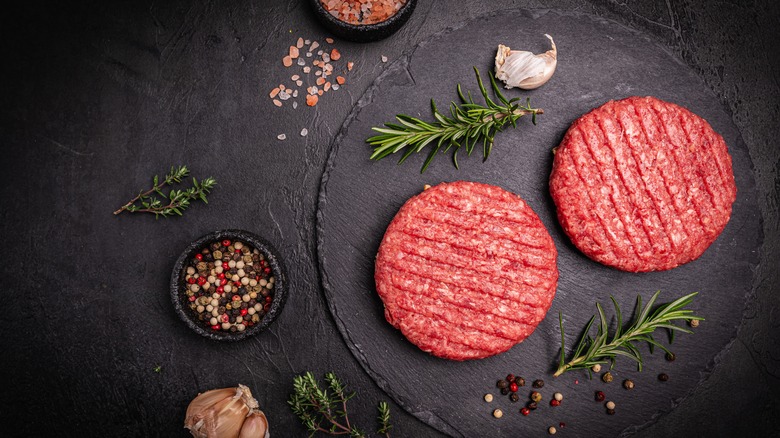
Burgers, in particular, tend to release more of this liquid than whole cuts of steak. That's because ground beef is made by chopping up the muscle, which disrupts its structure and allows moisture to escape more easily during cooking. The result is that familiar red liquid oozing a bit dramatically onto your plate. It's important to remember that the presence of myoglobin isn't an indicator of doneness or safety. Color alone isn't a reliable measure of whether ground beef is fully cooked, because myoglobin can remain pink even after the meat reaches a safe internal temperature. That's why knowing the best temperature range for grilling burgers is so important.
Understanding myoglobin helps demystify a common kitchen moment. That red liquid isn't blood, it's not a sign your burger is undercooked, and it's not something to fear. It's simply muscle chemistry at work, and a reminder that meat is a biological material, not an inert product that magically appears at the butcher counter. Knowing what myoglobin is doesn't make a juicy burger any less appealing; if anything, it explains why properly cooked beef stays moist and flavorful. Whether you're a grill-master or simply a burger-lover, knowing how myoglobin works is an essential tip when it comes to grilling the perfect burger.