

9 Old School Salads That Quietly Vanished
Food trends come and go, but salads have remained pretty stalwart in their status on menus everywhere. However, the types of salads have varied vastly over the decades, depending on diets, food availability, technology, and more.
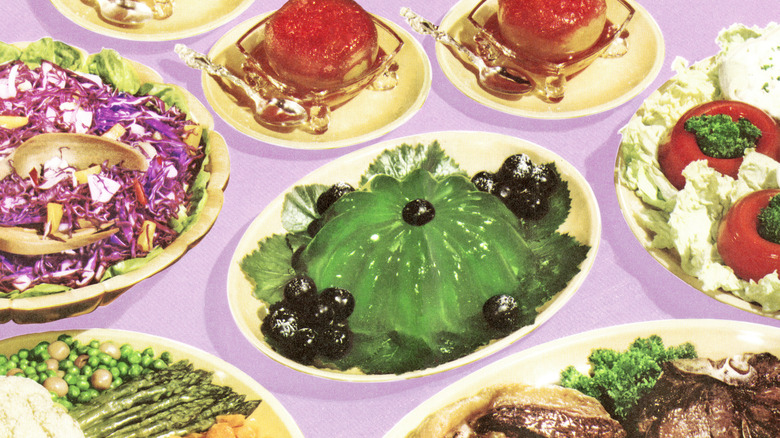
Certain salads have stuck around since their inception, like the classic Caesar salad and picnic staples like potato salad. Others haven't fared quite so successfully. Plenty of time has passed since we got over our obsession with molded Jell-O salads, although they sometimes continue to crop up on a table or two for nostalgia's sake. Although, fortunately, they seem to be of the sweet variety, rather than the sweet-savory concoctions our grandparents were familiar with. For a time, with the rise in popularity of instant foods and refrigeration technology, salads became centerpieces — showstoppers at dinner parties and the stars of every table.
Of course, like all trends, the ebb and flow of salad (and the type of salad) is a constant. Dressing-heavy, sticky-sweet, or overly creamy salads were discarded in favor of recipes that actually highlighted the ingredients that were in them, instead of covering them up under a blanket of mayonnaise or marshmallow. These are nine old school salads that rarely grace modern tables anymore.
Shrimp Louie
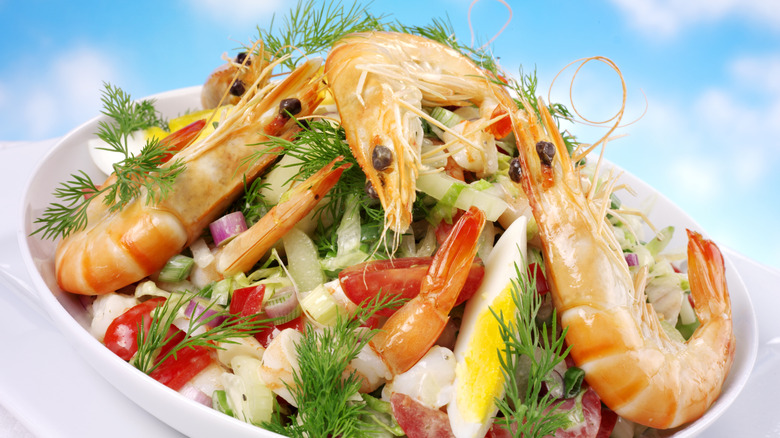
Shrimp cocktail may still be sticking around grocery store seafood departments and certain restaurants, but one other cold dish starring the tiny crustacean is a lot less likely to show up on a menu near you.
Shrimp Louie is a salad that first rose to popularity on the West Coast during the early 1900s, when seafood was in abundance and there was no shortage of creative ways to dress it up for consumption. The cold salad was less side dish and more main course, since it was loaded with protein-heavy ingredients like the afore-mentioned shrimp, hard-boiled eggs, and, depending on the recipe, crab meat. The salad also contained lettuce, tomatoes, asparagus, and sometimes cucumber and onion. It was finished with fresh lemon wedges and Louie (or 'Louis') dressing, a blend of ketchup, mayonnaise, chili, horseradish, and vinegar. Again, like many salad dressing recipes, ingredients may be added or taken away, depending on the chef.
However, as the years have gone by, shrimp Louie — and crab Louie, its cousin salad — have quietly disappeared from many cookbooks and restaurants. Unless you're a West Coast (specifically, San Francisco) native or tourist, you're unlikely to find this once-popular dish anymore.
Tomato aspic salad
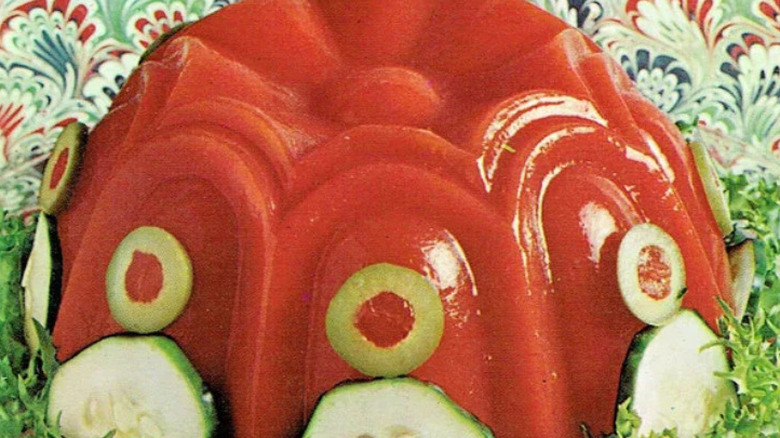
In the 1950s and 1960s, it seems that everyone and their mother was using gelatin. Beyond the instant Jell-O mixes we know and love in an array of fruity flavors, there were also vintage Jell-O appetizers that incorporated cheeses, meats, vegetables, and sometimes a combination of all three.
In many of these recipes, aspic was used. Aspic is a savory gelatin, usually flavored with meat stock or broth. These were frequently the base of many salads, which were popular among home cooks as well as in restaurants. After all, what looked more impressive at an important dinner party than a molded salad studded throughout with carefully chopped and arranged vegetables, garnished with swirls of cheese or savory mousse? The world of aspic salads is a vast one, but the one we're looking at specifically is tomato aspic. In these recipes, gelatin would be mixed with vegetable or tomato juice and spices, with the option of adding other seasonings like Worcestershire sauce, Tabasco sauce, and lemon juice. Chopped veggies could be included, or it might be treated as a sort of molded Bloody Mary, garnished with a generous helping of mayonnaise for dipping. Eventually, people realized they didn't want everything they ate to jiggle and aspic salads — tomato aspic salads included — disappeared.
Dandelion salad
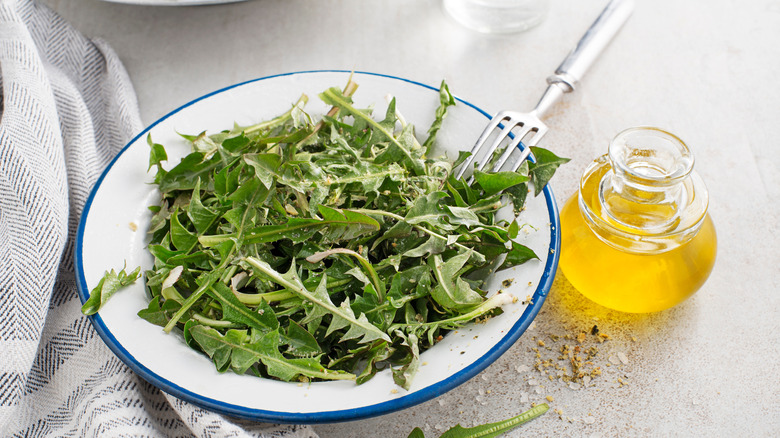
Dandelion salad sounds almost quaint, doesn't it? Like something you'd make while you're playing in the woods near your house, pretending to be fairies or something (definitely not based on a real experience). In fact, the story behind dandelion salad is actually a lot less whimsical and a lot more depressing — literally.
While dandelion salad is still eaten by those who forage today (and has been around since medieval times), it was most popular during the Great Depression, when food was hard to come by (and expensive) and dandelions were edible, full of vitamins and minerals, and plentiful. Easy to find, these bitter plants were made more palatable with the help of lemon and salt, and could be dressed up for a brightly colored salad that helped fill bellies in times of need.
The popularity of dandelion salad has dwindled in response to more robust economic times, but dandelion greens are still a relatively popular salad ingredient. However, we advise against foraging for these plants dependent on pesticide use in your area.
Bologna salad
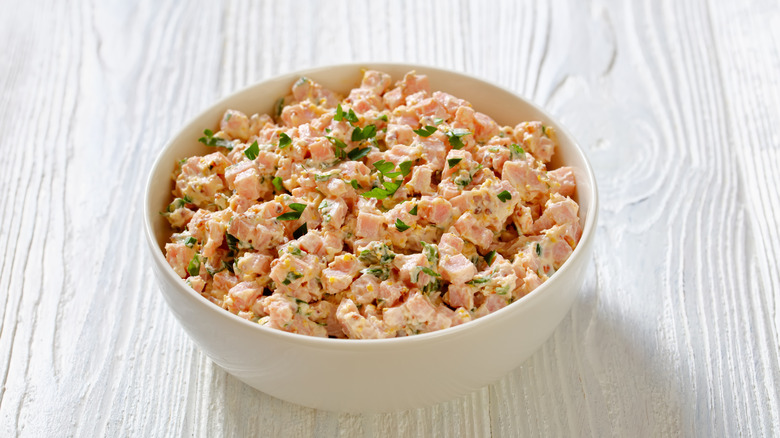
Tuna salad, chicken salad, and egg salad all have their place in the world. Love them or hate them, they are staples at potlucks and in lunchboxes and have been for decades. One salad of a similar ilk that has fallen out of favor, however, has to be bologna salad.
The lunch meat that inspired the salad came about in a similar manner to the dandelion salad — out of the Great Depression. While ham salad is still relatively popular in certain states, those who couldn't afford ham opted for bologna instead. The mixed meat was cheaper and easier to procure, which made it a popular option for households operating on a budget. Aside from the bologna, this salad came together with the help of mustard, mayonnaise, relish, and salt and pepper — largely shelf-stable ingredients that could be found in most American homes at the time.
As time has gone on, however, bologna salad doesn't show up in lunch bags much anymore. While tuna salad sandwiches won't make you a popular choice to sit next to in a classroom (or on an airplane), they still have their place in the world. It seems that the time for bologna salad has, for the most part, passed us by.
Frozen cheese salad
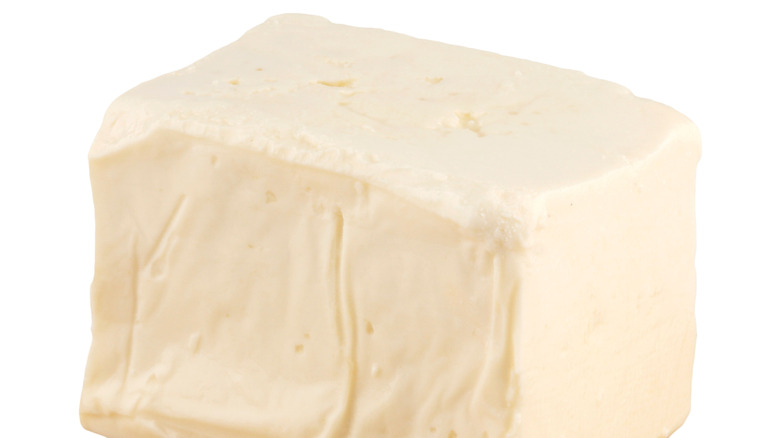
To paraphrase a certain Jeff Goldblum character, "You were so busy trying to see if you could do it, you didn't stop to ask if you should." That's our sentiments for this questionable salad. Frozen salads grew in popularity beginning in the 1920s as freezers became more widespread. Freezing food also allowed for the ingredients to remain in place and intact, as well as preserving their quality. Frozen salads remained in recipe books for decades, including this one pictured here from a 1970s cookbook.
It seems that the novelty of freezing dishes — including salads — outweighed the necessity. Enter frozen cheese salads. While you can freeze certain types of cheese, frozen cream cheese (a frequent star in these salads) can have an unpleasant icy and crumbly texture.
Like other frozen salads, frozen cheese salads were frequently molded, which made for easier serving, and gussied up with all manner of vegetables. Sure, it was an option at a dinner party, and, when sat on a table, it looked enough like food, but we certainly wouldn't be lining up to try it.
Lime cheese salad
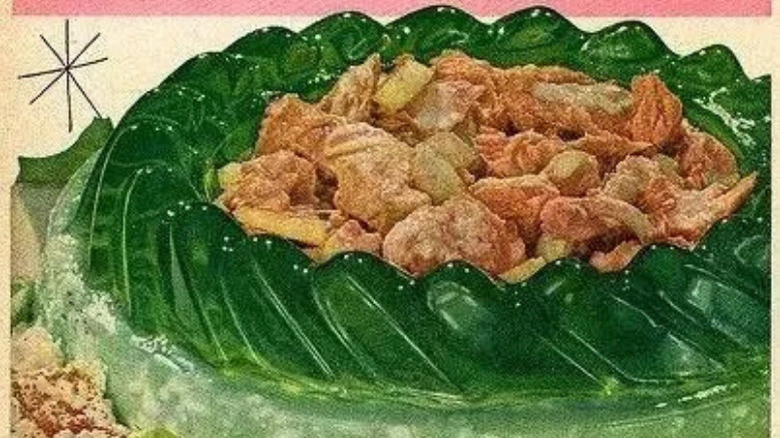
Lime Jell-O can be pretty great. We don't even mind it in molded form, or as an ingredient in the so-called dessert salads that are so popular in the South. Although, calling those marshmallow-infused confections "salad" isn't fooling anyone. Where we draw the line is when creative chefs decided that lime gelatin is a great vehicle for savory mix-ins like cheese, vegetables, mayonnaise, and fish.
A vintage advertisement from the folks at Jell-O offered consumers a recipe for a lime cheese salad, which used vinegar, grated onion, cottage cheese, and mayonnaise mixed into a mold. After de-molding, the salad was finished with a large quantity of seafood salad in the center. Yes, instead of defiling just one salad, Jell-O provided customers with a revolting double shot. Lime gelatin and cottage cheese salads still occasionally pop up in some cuisines, but they have fortunately faded into relative obscurity for anyone who doesn't want minced onions mixed with their dessert.
Deviled lettuce delight
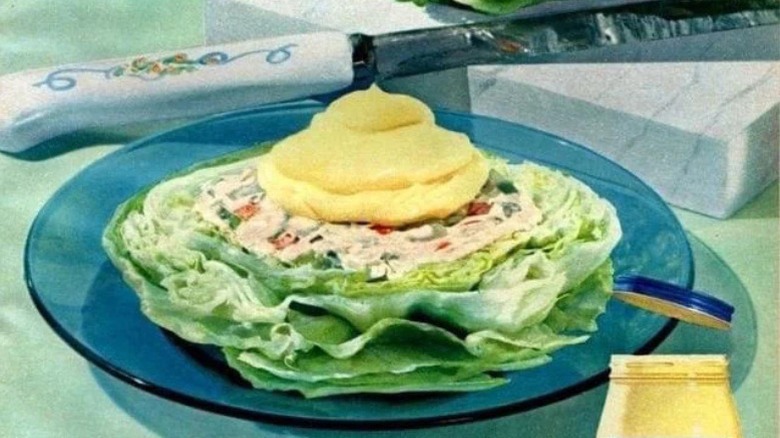
While we've already seen a few salads that were arranged in a special mold for eye-catching presentation, this particular salad opted to keep things a little more organic. Instead of a manmade mold, it relied on nature — by using a hollowed-out head of iceberg lettuce as its salad vessel. Panera's bread bowls have nothing on this.
Known as deviled lettuce, deviled lettuce salad, or deviled lettuce delight, this salad was a recipe of choice in the 1960s. The hollowed-out head of iceberg lettuce was filled with a mixture of Miracle Whip, cream cheese, deviled ham, celery, green pepper, pimento, and onion. It was chilled and then sliced into rounds and garnished with yet more Miracle Whip for a crispy, crunchy, fresh flavor. We can almost see the appeal of this, if you really enjoy mayonnaise-heavy salads and sandwiches. However, the unwieldy nature of trying to saw a slice off a stuffed head of iceberg lettuce makes us glad this one hasn't made it past the twentieth century.
Snickers salad
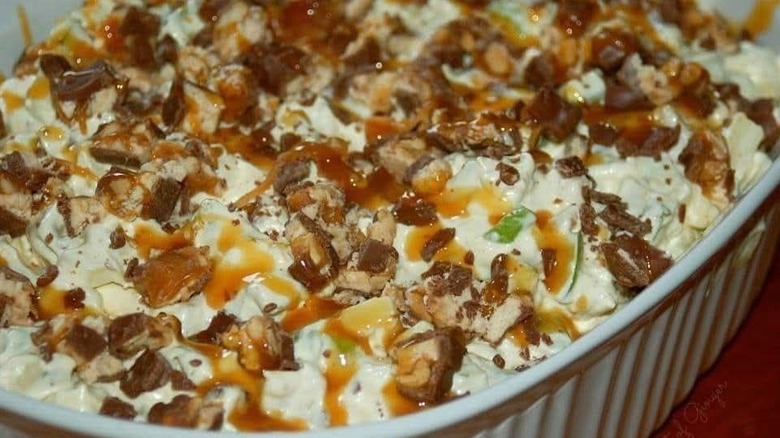
You have to admire the boldness of a salad containing a candy bar to even call itself salad. Sure, we're used to sugary ingredients like maraschino cherries and marshmallow fluff popping up in such Southern delicacies and Thanksgiving sides as ambrosia salad, but chocolate?
Yes, Snickers salad isn't a misnomer — this caramel-filled confection does actually contain chopped up chunks of the candy bar as a real ingredient. Also along for the ride is pudding mix, Granny Smith apples, Cool Whip, and caramel sauce. The origins of this dessert salad are unclear, although it definitely originated in the Midwest, a favorite at potlucks and church gatherings. Now, however, it's unlikely you'll find it reappearing on websites among lists of popular or must-make salads. Aside from a fun novelty factor or a foray into true indulgence at the dinner table, we can't see Snickers salad making its way across the country with any sort of regularity.
Celery Victor
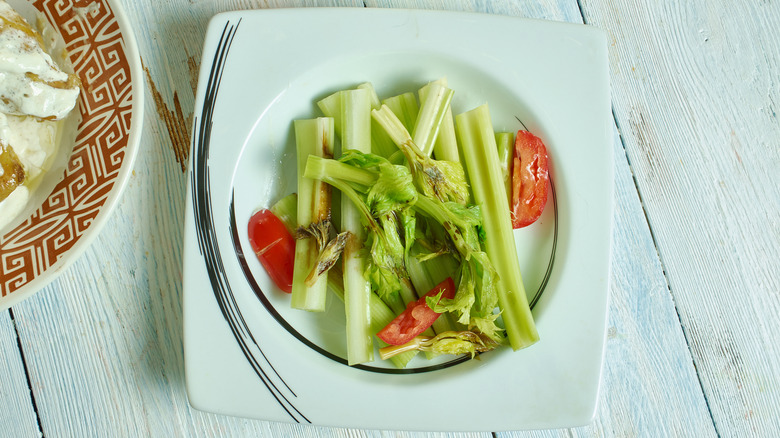
Celery Victor has quite an esteemed reputation, as its name might suggest. Invented in 1910 by Victor Hirtzler, who was head chef at San Francisco's St. Francis Hotel, celery Victor (named for its creator) was a simple, elegant dish. Hirtzler himself had worked in both Paris and New York, as well as for two different royals.
The dish is deceptively simple: marinated stalks of celery that are chilled and then tossed with peppers and seasoned with vinegar. Elegant and restrained, celery Victor could be arranged in different ways, with the plating depending on the vision of the cook.
Perhaps it was the simplicity of the dish that caused it to fall out of fashion. After all, it's basically celery and vinegar, and who wants to pay for that in a restaurant? While you can certainly make celery Victor at home, we recommend having a hearty meal to serve afterwards.