

This Underrated Vegetable Is Actually One Of The Most Nutritious In The World

Poor little watercress rarely gets the spotlight. It's often treated as little more than a garnish, casually tucked into a sandwich or scattered across a plate for color. But nutritionally, this peppery green quietly outperforms many of its brethren veggies in the brassica family, which includes kale, broccoli, and arugula. In fact, watercress is considered one of the most nutrient-dense foods in the world, which means you're getting the most bang (vitamins) for your buck (calories). If you need more proof, it was ranked number one on the Centers for Disease Control and Prevention's Powerhouse Fruits and Vegetables list. This common creekside plant has, per serving, more vitamin C than oranges, more calcium than milk, and more iron than spinach.
So, why aren't we seeing it stocked on every shelf in Whole Foods or Trader Joe's and shoved in our faces by online influencers? For one, watercress can be difficult to find in mainstream grocery stores, namely because it's challenging to grow and ship on a nationwide scale. The slightly bitter green is a perennial aquatic plant that grows alongside shallow streams. You're most likely to find it in the wild next to a babbling brook, as it loves a constant source of fresh, moving water. Shipping watercress is a challenge because of its extremely high perishability and short shelf life. This means that, once harvested, it's among the potentially surprising foods that should be refrigerated. If you can find a fresh patch, you'll probably have the best luck growing your own by sticking the stem cuttings in water and waiting for roots to form.
Watercress should be the next kale
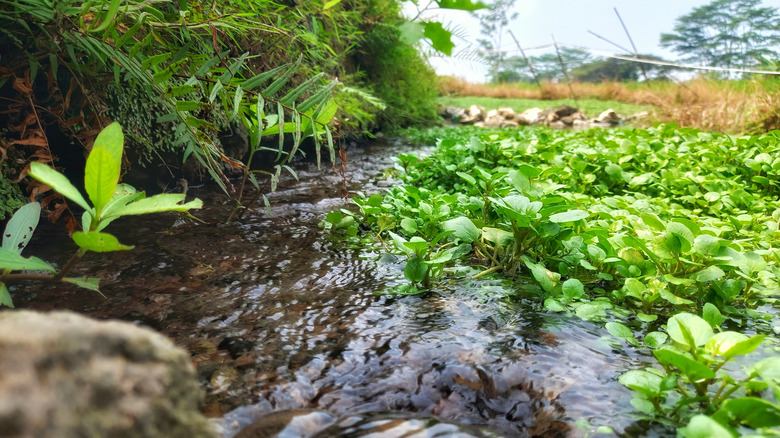
Watercress certainly isn't a trendy new vegetable on the up and up. It's been eaten for thousands of years in Asia and Europe, and there's plenty of folklore to go around. One story involves Hippocrates, the "Father of Medicine" himself, who was said to have built his first hospital by a stream in order to harvest the plant. While that's most likely a myth, it is true that ancient Persians, Greeks, and Romans used the plant for medicinal purposes. Today, Asian cuisine often employs it in stir-fried dishes and soup, while the Brits love it in those fancy afternoon tea sandwiches said to be popularized by the Duchess of Bedford. Though it's common to find watercress growing wild in parts of the U.K., it's considered invasive by a whopping 46 states in the U.S. Perhaps they didn't get the memo that it's a nutritional powerhouse.
If you'd like to forage for the greens, take care to properly wash them, because there are all kinds of microscopic parasites that can linger in untreated water. Despite its incredible benefits, watercress still isn't a superstar yet, so you'll have to work on getting more of the greens into your life. It's one of the best vegetables you can add to your daily smoothie, and its spicy bite is wonderful in a salad with milder greens. The sharp, slightly bitter flavor also makes it ideal for cutting through rich foods, bringing zing when added to egg dishes or blended into pestos. Best of all, because it's so nutrient-dense, even small amounts can add meaningful nutritional value.