

The Essential Design Element You Need For A Mid-Century Modern Kitchen

We may receive a commission on purchases made from links.
Midcentury modern (MCM) emerged as a design style between the 1930s and 1960s, a response to the ornate, OTT elements that distinguished Art Deco and Victorian décor before it. Like vintage cookbooks that are worth a pretty penny today and iconic, vintage hummingbird cake from the '60s, MCM is one of the rare remnants of the 20th century that seems to improve with time, a sleek, deceptively simple, timeless aesthetic that suits many modern vibes. You don't need to go full "Mad Men" to incorporate midcentury modern in your contemporary kitchen, but there is one element that you definitely shouldn't skip.
If you ever needed a reason to knock on wood, you wouldn't find yourself pressed for options in a MCM kitchen. Wood tones, and especially warm ones with visible grain, were ubiquitous during this period, and are a facet of the design that you shouldn't pass over when planning your 2020s homage to MCM, even if you only plan on sprinkling in certain characteristics.
When Foodie's sister site Chowhound spoke with a bevy of designers regarding MCM influence in today's kitchens, they were clear: wood is what you want. Todd Harmon of Harmonia Living put it plainly: "In a mid-century modern kitchen, wood is never just a surface — wood is the soul and heart of the space." The type of wood you opt for is widely variable, depending on your budget first and foremost, followed by the durability of materials that your household requires.
Ideas for incorporating MCM wood looks in your kitchen
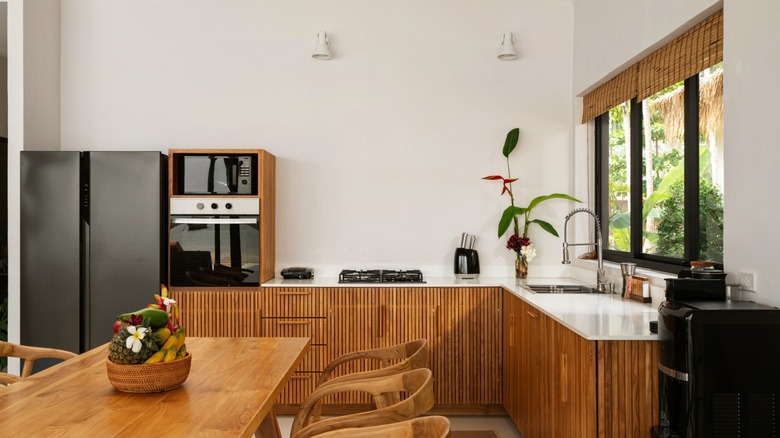
You can still embrace modern countertop choices in your kitchen like marble, quartz, or even stainless steel, while also nurturing a very warm, evocative midcentury modern look with wooden bar stools at your island, Shaker-style cabinets, or even wood-clad range hoods. Lean into wooden implements in your kitchen to really punch up the aesthetic, from items as small as coasters made of wood and felt, all the way up to an eclectic wooden sideboard sporting carved geometric shapes. Walnut and teak were popular choices in MCM's heyday, but don't be afraid to pick something that suits your budget and personal vibes. The wood grain look is important for authenticity, but not so much the actual medium. Darker woods were hot in the middle of the 20th century, but we've seen some very groovy midcentury looks built around lighter stains.
Keep in mind that midcentury modern elements should serve your design style and not the other way around. If you have a standout feature in your kitchen, like retro '50s checkerboard flooring, the wooden materials of MCM can work in harmony with it. Wood is, after all, one of the most neutral and forgiving of materials. The simplicity and elegance of midcentury modern design is within reach at all strata of budget, tastes, and resources. Look up inspo centered around midcentury wood, and you won't steer wrong.
Static Media owns and operates Foodie and Chowhound.