

Do Different Colored Caps On Bottled Water Actually Mean Anything?
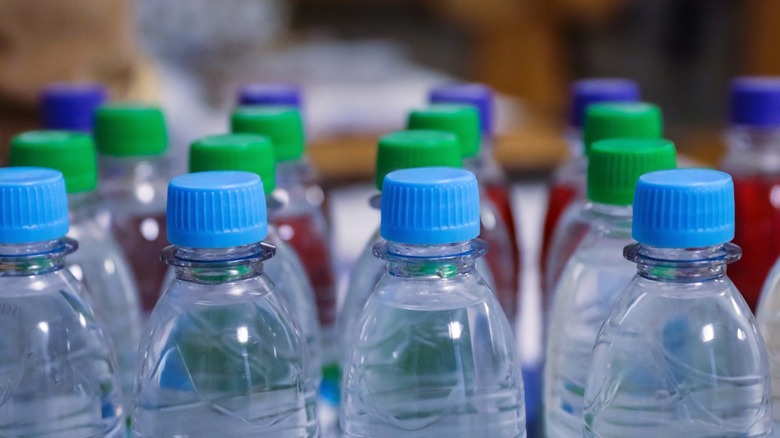
You know why we drink water in the morning and, indeed, all day long ... it's the nectar of life! Bottled water is a portable, relatively inexpensive way to get your hydration fix without too much effort. A mistake you're making when buying bottled water, however, is falling prey to a common internet legend positing that the color of the cap on your bottled water is a code for its contents.
On Facebook and other social media sites, we see the essence of this assumption: that different colored caps "mean" something, with blue typically taken to mark "natural" water, black meaning alkaline, red for electrolyte water, green for flavored, and white for filtered. TikTok is also rife with reels relaying this misinformation, although we've seen blue tied to spring water and white to "processed" water. Certain so-called news outlets have even picked this story up, running with the idea that there's a systematic color chart for bottled water labeling.
However, thanks to an investigation from Snopes, the long-running site dedicated to fact-checking, we see that none of this holds water (pun fully intended). There is not, in fact, any one color-coding scheme for water bottles, with many popular brands veering off-book from the alleged meaning of the caps. Fiji Water, for example, has a blue cap but is not spring water, while Aquafina has been known to place different-colored caps on bottles with identical contents. Meanwhile, Costco's Kirkland brand bottled water, which is produced by the popular brand Niagara, puts white caps on its purified water ... but so do tons of other manufacturers, since white is the most common color for water bottle caps.
For info about your bottled water, look at the label and not the cap
While there is some scant information that different bottled water companies may use their own system of colors to differentiate unique product offerings — Snopes points to an Italian bottler that uses red and blue to denote still versus sparkling water, respectively — it seems that bottle cap color may be simply rooted in aesthetics. Of course, as is the case with almost everything in manufacturing, we also wonder if cost is sometimes an issue.
If you really want the lowdown on your bottle of water, look at the label. The FDA, which regulates the safety of bottled water (as opposed to the EPA, which safeguards drinking water from your tap), requires that manufacturers list all added ingredients in the water, which might consist of electrolytes or flavorings, either natural or artificial. Bottled water manufacturers are required to list on the label where the water was sourced, as well as to provide a phone number that consumers can contact for more information.
Furthermore, bottled water manufacturers can't just randomly call their products spring water, filtered water, purified water, or anything else. These labels mean something and must be backed by facts. Educating yourself on bottled water classifications vis-à-vis federal requirements is part of your job as an informed consumer, helping you make the best choice about what companies to support and what products suit your needs. The color of bottle caps really shouldn't factor into the equation, unless you have aesthetic preferences that override other criteria.