

Good Luck Trying To Find This Popular Dessert 'Salad' From The '70s
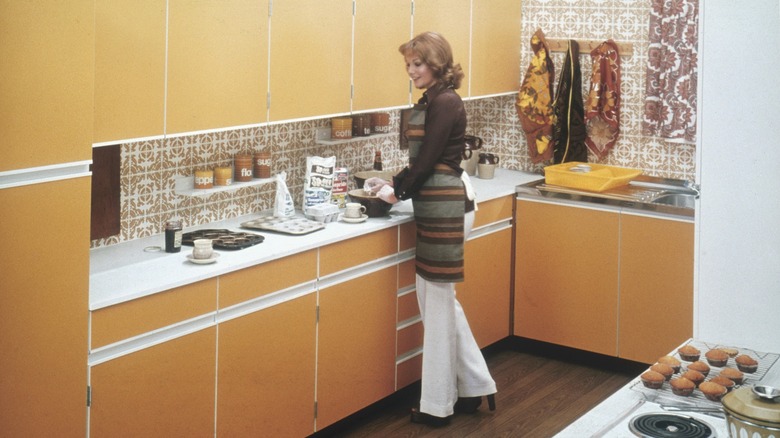
Ina Garten famously opined that bringing Jell-O salad to a dinner party was a red flag, so we can hardly imagine what she would think about ambrosia salad. Here's the first thing to clear up: Ambrosia is not a "salad" in any way that makes sense to contemporary persons of sound mind. Rather than a bowl of leafy greens, ambrosia salad is a mixed fruit concoction laden with marshmallow fluff and/or sour cream and/or Cool Whip and/or coconut and/or flavored gelatin. Confused yet? Join the club.
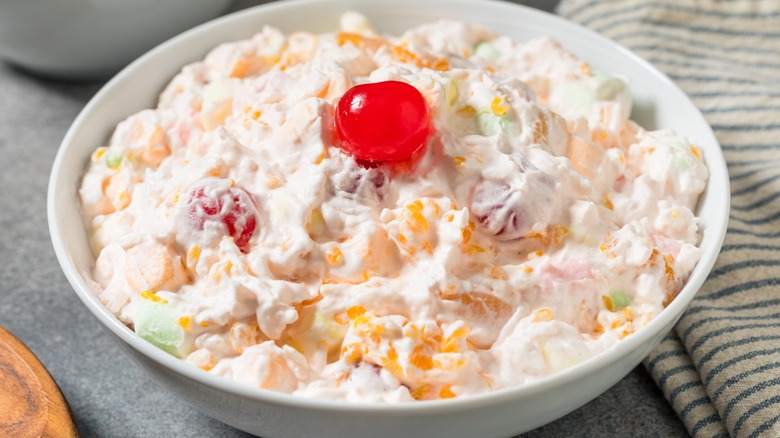
In the South, ambrosia salad is something of a lingering tradition, especially around the holidays. It got really big in the '70s, where having a bowl on your table was considered a mark of sophistication. Southern folk have been known to put mayo in their fruit salad, and ambrosia isn't far off the mark... indeed, mayonnaise is yet another ingredient that sometimes sneaks into the bowl in some ambrosia recipes. Here's another thing you should know about ambrosia – nobody can agree what goes in it.
First of all, the fruit is up for discussion. Oranges are traditional, and hearken back to the fact that, once upon a time, ambrosia celebrated rare and pricey ingredients (like the coconut that also appeared in the 1800s). Today, pineapple and maraschino cherries get a lot of play, but that's far from an exhaustive list. Pears, peaches, and papayas are just some of the fruits that you see in ambrosia, and that's not even getting started on all the condiments that can be added to the dressing. Basically, if it's white and opaque, somebody has used it to coat their salad.
Ambrosia is a historical dish that's an oddity today
It's little wonder that ambrosia is considered kind of funky by a lot of people, and it isn't seen much in the 2020s. Does it qualify for our list of foods from the 1970s that you can't find now? Unless you know a lot of Southern nanas, it just might. Once upon a time, over 150 years ago, ambrosia was reckoned a luxury, thanks to hard-to-find ingredients. Around the 1870s, recipes began popping up like wildflowers in ladies' magazines from coast to coast. Somewhere along the way, ambrosia became associated with the American South, but there's no record that it started there. Ambrosia became a capital-B Big Deal in the middle of the last century alongside its spiritual cousin, Ina Garten's loathed Jell-O salad. Fortunately, or unfortunately (it's a toss-up), ambrosia fell off the map since before the turn of the millennium, and is considered something of a curiosity today.
If you want to try your hand on bringing ambrosia salad to the 2020s, we have a few suggestions to keep in mind. Fresh fruit may go over better than canned, especially if you choose fruits that are fresh and in-season. Try to control the sugar content, and resist the Nixon-era urge to dump marshmallows and whipped cream and table sugar all up in there. Fruit is sweet enough as-is, so perhaps opt for some Greek yogurt for a hint of tartness if you are sold on the mini marshmallows? Don't shy away from coconut, as that's an OG ingredient that gives some much-needed texture. And, out of consideration to your loved ones, maybe leave the Jell-O out of the equation.