

You Need To Stop Ignoring This Basic Coffee Shop Red Flag
We may receive a commission on purchases made from links.
It's a common occurrence at a coffee shop, one as typical as burning your tongue on a still-cooling drink. You're ordering a house-made croissant at your local hole in the wall, or maybe sipping one of Starbucks' handcrafted drinks. The smell of freshly-ground beans wafts through the air. Did you just hear the signature shriek of a milk steamer? It may disappear into the soundscape you expect at a café, but here's a thought: it shouldn't be happening.
No matter what amateur baristas might claim, the steam wand shouldn't be making an ungodly racket. It's not an unavoidable part of heating milk, and, in fact, might be a warning sign that the employees haven't been properly trained as to how to use the equipment ... or, worse, that they aren't properly cleaning their tools. If a steamer is inserted into a clean pitcher of cold milk at the proper angle and the machine is turned on at full power, it will generate enough steam that no screaming takes place. If, on the other hand, the barista doesn't turn it on all the way, doesn't position the milk pitcher correctly, or, heaven forbid, the milk has previously been steamed or the wand isn't clean, an insufficient amount of air will eke through, causing a ruckus.
This goes for the industrial steamers that your baristas use at coffee shops, as well as the convenient little steamers that you buy for home use. With most electronics and kitchen gear, it's a safe truth to assume that, if it's screaming, something is wrong. Come to find out, that applies to steaming milk as well.
Here's how steaming milk should go
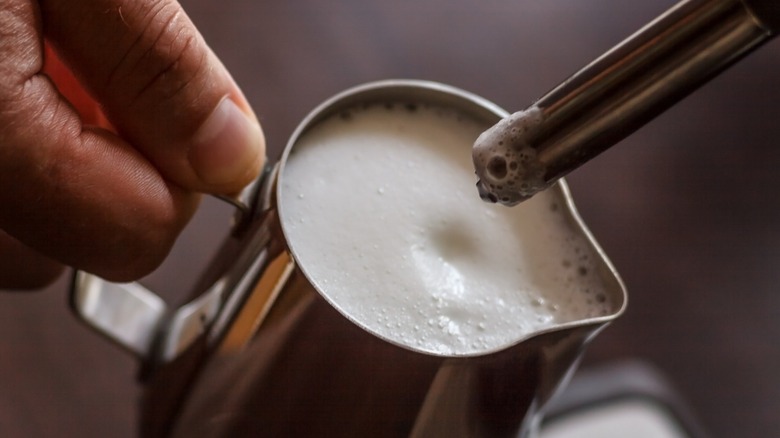
Scandinavians may be known to add cheese to coffee, but many American coffee drinkers like a java with steamed milk. If you know how milk is supposed to be properly steamed, you can feel free to side-eye your baristas for not knowing how to keep the steamer from screaming — and maybe, to judge whether the establishment is a place you feel comfortable ordering from. First, you need to briefly blast your wand to purge any water in the lines. The wand should go right below the surface of your milk. Don't be afraid to turn the machine on full blast, as this is actually how it's meant to work! Let in a bit of air for the first three to five seconds, and then lower the head of your wand and let the so-called "vortex" do its work spinning the milk around. The spinning will break the air bubbles into smaller bubbles, creating that attractive, luscious foam ... no shrieking required, or even wanted.
Social media coffee lovers note that your technique might vary if you are using non-dairy milks, such as oat milk or soy milk. A little trial and error is never a bad thing when you are an amateur. When you are purchasing an overpriced coffee at a café, however, one hopes that the so-called professionals know what they are doing. Otherwise, maybe you want to second-guess your patronage.