

One Of Judy Garland's Best Home Cooked Meals Featured This Retro Ingredient

We may receive a commission on purchases made from links.
We previously covered Hollywood songbird and actress Judy Garland's masterful shepherd's pie, a time-consuming dinner that required, in part, roasting an entire lamb's leg and grinding the meat by hand. The recipe, which was published in The Evening Sun, paradoxically also included two convenience foods: potato flakes and cream of mushroom soup. The contrast of intense prep and cooking shortcuts is definitely unique, and, unless you squint at Garland's list of ingredients, you might be forgiven for overlooking an item that's likely to make modern home cooks pause and go "huh?" That would be onion juice.
It may not have ever occurred to you that you could juice an onion — or that onion juice might be anything desirable instead of a smelly byproduct left on your hands after chopping a bulb for your meal — but you can. In fact, you do want that fragrant, piquant onion juice. Onions are made up largely of water ... around 89%, actually. Sometimes, if you want the essence of onion in your dish, but not the actual onion flesh, onion juice will set you right.
There is a difference between white and yellow onions, but both can have juice extracted from them. The flavor will just vary slightly, the same way that the actual onions taste a bit different. Note that you can buy bottled onion juice on Amazon, where it's marketed as a "flavor enhancer." However, as is almost always the case when it comes to culinary matters, we believe that fresh onion juice would probably taste better in your own shepherd's pie or just about anything else!
It's so, so simple to make onion juice at home
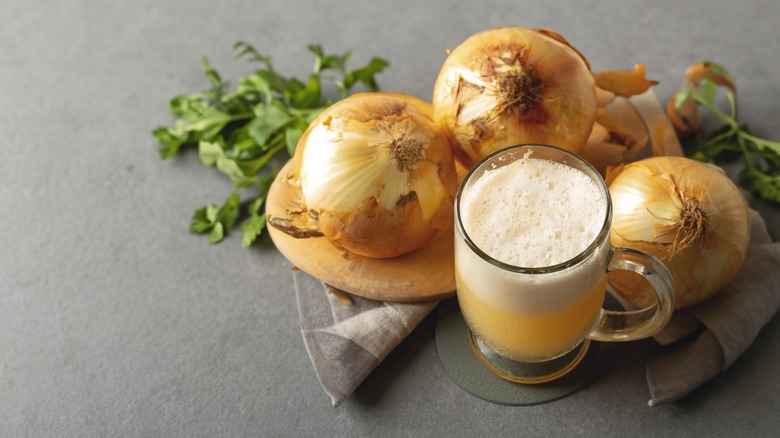
Some uses we can conceive of for onion juice might be marinades and sauces (ooh, BBQ sauce!), dips, salad dressings, and as a chew-free umami kick inside ground meats like burgers, meatballs, and kofta. Speaking of meat, onion juice is an all-natural meat tenderizer. There's no need to buy a special product, either. If you have onions, you can pretty quickly and painlessly make onion juice using one of a few different methods. Basically, you want to break down the onion and extract the solids so that only the juice is left behind. You won't get buckets of the stuff at a time — at least, not without juicing bushels of onions — but a little goes a long way, so you probably don't need much.
Note that Judy Garland's shepherd's pie recipe, which produced two pies (one for dinner and one to freeze), only called for a half-teaspoon of the stuff. If you have a handheld grater or a blender, you can macerate the onion very finely and then push the pulp through a sieve or piece of cheesecloth to strain out the solids. If you have an actual juicer, feel free to go hog wild and make onion juice just like you would with citrus or other fruit. The only preparation necessary is removing the onion skin and root and thoroughly washing the outside to remove any dirt or unwanted particles. As for storage, while we normally discourage freezing raw onion because the end product can be watery, this isn't altogether a bad thing for onion juice, provided it's well-sealed against freezer funk.