

How Big Your Prime Rib Needs To Be For Your Next Dinner Party

Planning a perfect high-end dinner party requires more than just drink selections and figuring out how to attractively stack plates for a budget table setting that looks bougie; you also need to nail the main course. If you've selected prime rib as your protein, that's a bold and opulent choice, but you also need to know exactly how much to serve as a function of how many guests you're expecting. Just imagine what a faux pas it would be to underestimate how much of your entrée to purchase and prepare! Luckily, knowing how much prime rib to dish up is pretty cut and dry.
Prime rib, which is slightly different from a rib roast, may be bought boneless or bone-in. We recommend that you buy bone-in prime rib for fork-tender meat, but you, of course, can make your own choice. With a bone-in cut of meat, you should plan on about one pound per guest. If you are buying a steak by the rib, that's about one rib for every two guests. For boneless prime rib, estimate half a pound or ¾ pound per guest.
If you are serving children, halve those numbers. If you have big eaters or desire some leftovers — next-day prime rib sandwiches are the bomb-dot-com, after all! — go up to one and ¼ pounds per person. Of course, appearances matter. For a truly luxurious, over-the-top occasion, you might want to present each guest with their own steak on the bone, in which case you would allot one bone per guest. A full prime rib has seven bones, just as a point of reference.
How to pick your perfect prime rib for a dinner party
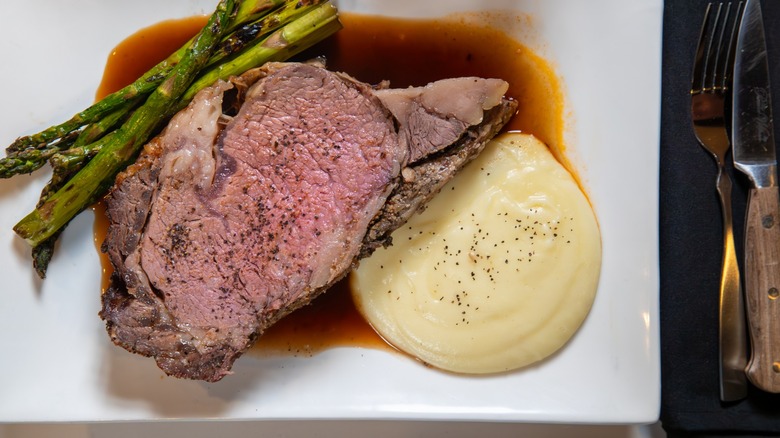
If you don't need a full-sized prime rib, ask your grocery store butcher to cut it down to size. If you want a boneless piece of meat, you can also ask the butcher to debone the cut for you, although, again, we encourage you to really reconsider this. A boneless prime rib is definitely more convenient (and you may appreciate not paying per-pound prices for the bones), but there is ample evidence that the bones help the meat cook more evenly.
Also, keep in mind that prime rib is a premium cut of meat, but there are different grades of meat that include fancy cuts. Bespoke butchers or meat delivery services may offer you a better quality of meat than you can find in the grocery store. These cuts will almost certainly cost more, but if you are planning a lavish dinner party for a special occasion, the extra money may be worth it so that you know you are sourcing the best for your guests.
Meanwhile, USDA prime is considered the nicest grade of beef that consumers can easily source at stores. Even though prime rib has the word "prime" in it, this doesn't have to do with the grade of the beef. In other words, not all prime rib is USDA prime-graded steak. Also, keep in mind that labels like "organic" and "free range" don't necessarily have much to do with quality, either, although they may command a higher price. When in doubt, have a conversation with a trained butcher about your needs and wants for your meal. They can point you in the right direction.