

You're Cooking Your Prime Rib Wrong. Here's How To Fix It
We may receive a commission on purchases made from links.
Cooking prime rib can be a daunting experience, starting with deciding how big your prime rib should be for your dinner party and continuing with the fraught question of whether you should buy bone-in or boneless meat for fork-tender results. All this, of course, doesn't even touch on the minutiae of cooking said prime rib. There are a lot of cooking "experts" who will ply you with tricks and hacks for perfect, buttery prime rib, but we're here to tell you that a lot of them are incorrect.
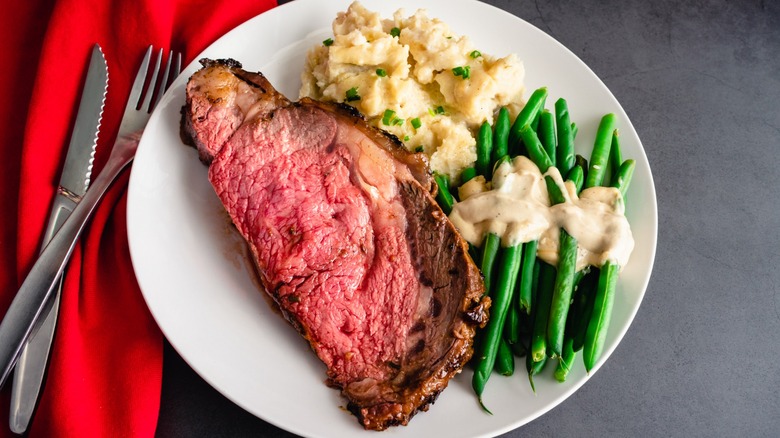
There's a body of wisdom that asserts the notion that prime rib is only worthy if it's cooked rare or medium-rare, with a uniformly rosy-red center. Come to find out, however, cooking your steak a bit longer than the crowd recommends has a lot of advantages. We're not talking about hammering a pricey piece of beef until it's well-done, obviously, but consider pushing the limits and letting your prime rib come up to 135 degrees Fahrenheit, which is solidly medium-rare, and not under.
Don't be afraid of leaving your prime rib cooking long enough to let the abundant fat marbling — the star attraction of this cut — really start to render and release the meaty, succulent juices into your beef. Also, a little extra doneness just under the crust gives a textural contrast that's enjoyable, and not incorrect. Uniformly pink/red meat can be mushy and feature inedible fat banding. Let your meat cook!
You don't need to change much to improve your prime rib
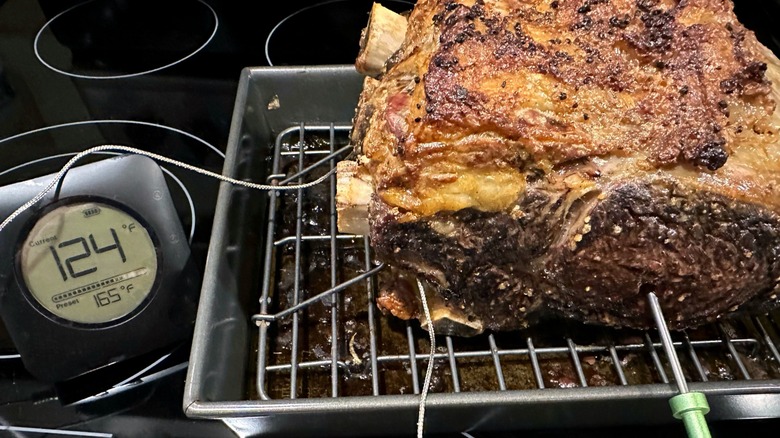
No matter what tried-and-true method you use for preparing prime rib, whether it's a blast of high heat followed by low-and-slow finishing, or a reverse-sear process that caramelizes the crust last, you don't really need to change up your game to guarantee much better prime rib than you're currently cooking. A change in internal temperature compared to conventional wisdom is what you're striving for, and that's easy enough to achieve.
A good meat thermometer is a must-have for any home chef, and that goes double when you're trying to nail that flawless medium-rare level of doneness with prime rib. We like the thousands of five-star ratings on a waterproof, ultra-fast ANDAXIN digital model (available on Amazon), which is inexpensive and allegedly accurate. The thing to keep in mind is that, when you take your prime rib from the oven and let it rest, carryover cooking will add around 10 additional degrees of heat. Therefore, the time to pull your pan is when the internal temperature reads 125 degrees Fahrenheit.
Bucking the culinary trends can be a scary concept, especially when it comes to such a prized cut of meat as prime rib. You're probably serving it for a high-stakes occasion, and you definitely don't want to mess it up. Trust us, however — cooking your steak just a bit longer than most folks recommend will pay dividends in texture and enjoyment, ensuring that you elevate your prime rib from a mushy pink mess to a firmer, tastier delight ... the way prime rib deserves to be savored.