

This Iconic Massachusetts Steakhouse Left Behind A Permanent Landmark After Shutting Down
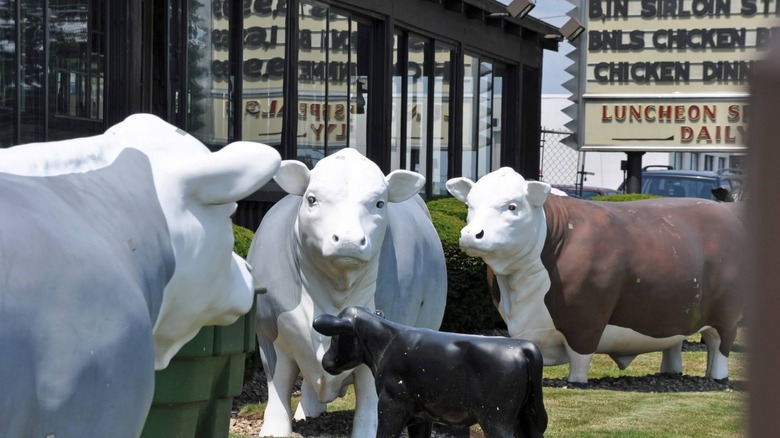
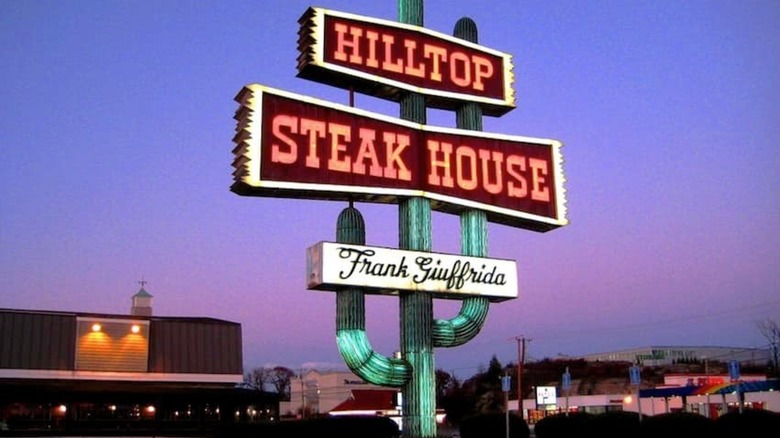
When you think of iconic Massachusetts restaurants, your mind may go to pre-Civil War eateries like Stone's Public House (which enjoys a local reputation for supernatural phenomena) or a classic upscale seafood shack like Union Oyster House, the oldest restaurant in the Bay State. Hilltop Steak House wasn't nearly as old, having opened its doors in 1961; nor can it brag that it's still serving guests — the ownership closed up shop in 2013. Still, the Hilltop left an indelible mark on Saugus, the city that the steakhouse and attached butcher shop called home. Its visible legacy today is a nearly-70-foot-tall neon cactus, which once boasted the Hilltop's name, and today advertises for the mixed-use community built on its footprint along Route 1.
If Hilltop Steak House bore a resemblance to any restaurant, it's the contemporary Oasis on Lake Travis, Texas's largest restaurant, which can seat more than 2,000 guests. At its zenith, Hilltop Steak House had room for 1,500 patrons, could park 1,000 cars, and often still had a line out the door. Restaurants & Institutions Magazine dubbed Hilltop the highest-grossing independent restaurant in the country for several years at the end of the 20th century. By the 2010s, however, reviews had fallen off and foot traffic was down. The Hilltop butcher shop survived two years after the restaurant shuttered, but it, too, closed in 2015 after an ill-fated move to nearby Weymouth.
The only relic remaining of the Hilltop is the towering cactus. When Avalon Bay Communities, the owner of the mixed-use development, erected ladders for crews to restore the sign, panicked passersby stopped their cars to ask if the sign was being torn down. Luckily, the improved, repurposed succulent still stands sentinel over the busy road (to date).
Massachusetts residents loved Hilltop Steak House
Eating at Hilltop was a rite of passage for many Bay State residents. This was not a mucky-muck, upper echelon steakhouse. The focus was on good value and good food. To that end, the value-oriented menu was fairly pedestrian (the owner once commented that you'd never find lobster thermidor under his roof), plates could not be split, credit cards weren't accepted until the 1990s, and there were no tablecloths. The dining rooms of the massive restaurant were adorned with vaguely Native American/Wild West paraphernalia and named after various midwestern and western cities like Sioux City, Carson City, and Santa Fe.
The Hilltop owed its success to restaurateur Frank Giuffrida, who, despite never graduating high school, had the business savvy to maintain over 30 years of explosive business in Saugus. When he sold the Hilltop in 1988, he made it part of the deal that his family would always eat for free and would never have to wait in line.
On social media, the subject of the Hilltop is fresh enough to bring out the nostalgia in former customers when you get them going on the topic. "The Good Old Days! Miss Hilltop and their prices," one Facebook user commented when an old Hilltop menu was posted. Another patron with rosy memories remembered the long wait for a table: "That place was the best in it's hayday you could go there put your name in come home get get cleaned up then go back have a drink at the outside bar and still have to wait." And a Redditor noted the existing landmark: "Miss this place. The cactus sign is still there and [I] see it on Rt. 1 every time I drive by."