

Forgetting This Step Can Ruin Your Prime Rib
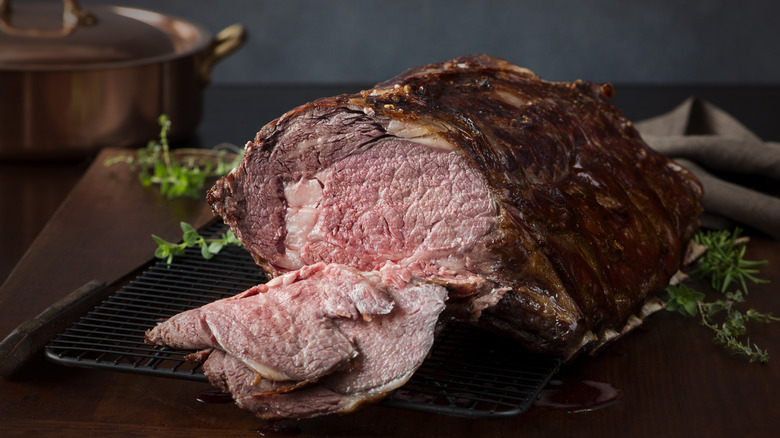
We've spilled a lot of virtual ink on how the pros "do" prime rib — Michelin-starred phenom Thomas Keller takes a blowtorch to his beef, for one — but there's one essential step we haven't covered. Knowing the temperature mistake to avoid cooking prime rib wrong is all well and good, but no amount of expert advice amounts to much if one side of your pricey cut of beef is soggy. And that can happen because you let it sop up its own juices in a roasting pan or baking dish. What you want, friend, is to place a rack beneath your meat.
Elevating your beef above the roasting pan on a wire rack accomplishes a couple of worthy goals. First, it allows hot air to circulate evenly around the cut, permitting it to cook more thoroughly. Moreover, the rack allows the bottom to stay elevated over the pan drippings, which means that it doesn't get mushy and lose its carefully-crafted sear from soaking in a puddle of meat juices.
Best of all, there's nothing complicated or expensive that you need to add to the equation. After all, you asked your butcher plenty of questions before buying that expensive side of beef; you need not lay out any more lavish expenses! A simple metal baking rack will do. All you need to do is sear your prime rib first, then place it on the rack and roast it as you normally would. This small step will pay dividends in texture and taste!
Social media endorses this critical step
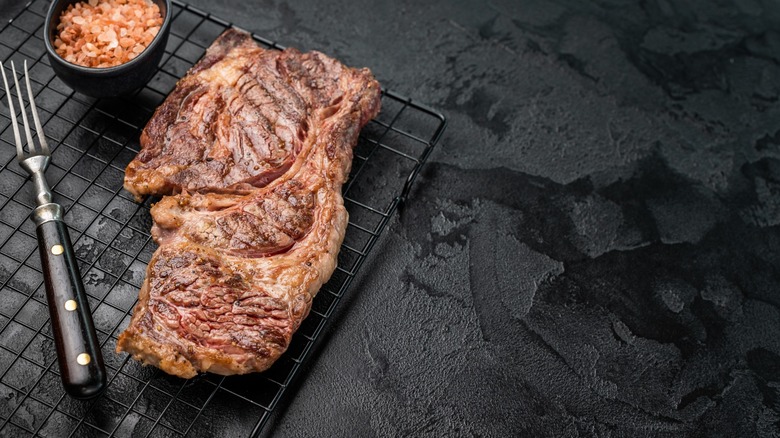
On a Reddit forum dedicated to cooking, dozens of comments weighed in on the topic of roasting prime rib on a rack, and most folks who chimed in were in favor of the prep step. "For sure use a rack, letting it sit in the juices will make that side weird," one commenter opined. "The rack allows for air/heat circulation," another explained. "When you roast it with out [sic] the rack that side of the roast kinda simmers or boils in its juices as they drip out." This also has professional backing, as Omaha Steaks Executive Chef David Rose encourages the very same practice.
Yet another Redditor writing in to the above thread added a new motivation: "I use a rack so that the fat and juices are separate from the meat. Makes it a lot easier to use them for Yorkshire pudding or gravy afterwards." Meanwhile, at least one Redditor was using the bones from their prime rib as a makeshift rack, allowing the flavor of the bones to infuse into the beef while also propping it up.
Considering that it costs very little in the way of either equipment or time to position your prime rib on a rack versus letting it sit on the bottom of the pan, we can't see a good reason not to elevate it. Most cooks serious enough to tackle prime rib at home already have a rack, and, if not, they are plentiful and relatively inexpensive. We think this is one small step with the potential to be a game-changer.