

Alton Brown's Prime Rib Roast Utilizes An Unexpected Tool For An Unforgettable Crust

We may receive a commission on purchases made from links.
Celebrity chef Alton Brown is one of our go-to sources for the science-y knowledge behind why cooking works. It's not surprising that Brown has a preferred way to cook prime rib, which he dubs his favorite part of Christmas in an episode of "Alton Brown Cooks Food," available on YouTube, dedicated to a standing rib roast. What is surprising is the offbeat implement that Brown uses to prep his meat for cooking ... a six-foot length of food-grade cheesecloth.
Basically, Brown buys his rib roast, the parent cut that produces prime rib, at least five days before he plans on cooking it. He unwraps the roast from any butcher paper or plastic, pats it dry, and swaddles it in cheesecloth. Then, he places the wrapped bundle on a drip pan over a baking sheet in the fridge until he's ready to cook it. This, he is careful to point out, is not the same as dry-aging, which is a more complex and specific process. No, what he's doing is getting the exterior of the steak incredibly dry, ensuring that, when he finally cooks it, the crust of the prime rib will sear and almost blister, making it unforgettably golden and flavorful. Thank the Maillard reaction at work!
It's true that this setup will occupy no small amount of refrigerator space for five days, but the results will pay off beautifully in a roast that Brown says is his favorite way to eat prime rib. On Facebook, a commenter who tried Brown's method for prime rib earned raves for the beauty and visible succulence of their meat.
Alton Brown has other secrets for remarkable prime rib
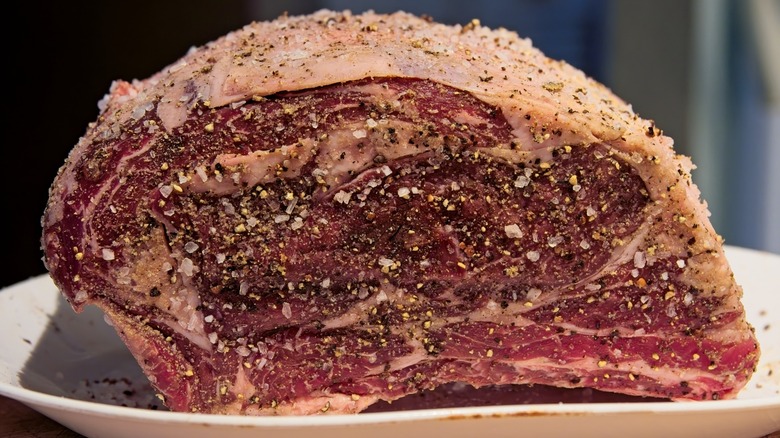
We've discussed that buying bone-in prime rib is the way to ensure that it's fork-tender; Alton Brown agrees. He is sure to leave the bones on while cooking. Once the prime rib has cooked, he slices off the meaty bones, hits them with naked flame — very much like fellow celebrity chef Thomas Keller, who hits his prime rib with a blow torch for supreme browning — and munches on them. Also notable is the fact that Brown only seasons his prime rib with a beef tallow rub and hand-ground black pepper plus kosher salt. If you are the type that wonders what kosher salt is, anyway, know that it's the key to perfect prime rib, because other salts don't stick nearly as well. Brown prepares a Yorkshire pudding with the beef drippings and lets the prime rib sit at room temperature. After searing it off in a high-heat oven, he says that it's ready to carve as soon as practical, since it has already rested.
If there's one note we might disagree with the mighty Alton Brown on, it's the fact that his prime rib, when finished, is definitely on the rarer side of medium rare. Cooking prime rib to too low an internal temperature is a mistake, as the inside tends to be mushy. If you like it that way, great! If not, simply utilize your probe thermometer and cook it a bit north of 125 degrees Fahrenheit, and not the 118 degrees that Brown goes with. Just don't skip the cheesecloth drying step for that unforgettable crust!