

6 Retro Ingredients That Turned Out To Be Problematic

The retail food industry has proven time and again that what is trendy one year can be cause for concern the next. And often, those concerns are deemed to be merited. After all, food dyes are the reason Pop-Tarts are banned in so many countries. Some ingredients that were popular in the 20th century and early aughts have been revealed via scientific studies to be problematic. It's not a question of whether they are "good" or "bad," as those words can be subjective; rather, this is about what science and changing cultural attitudes have to say.
Just like how formaldehyde, salicylic acid, and borax were banned from food in the early 20th century, some ingredients that served specific purposes in food production turned out to be potentially troublesome. For some, the U.S. Food and Drug Administration (FDA) has deemed them "generally safe for consumers" (often in specific quantities), while the European Union and other countries have banned them entirely because of the risk — be that potential or proven. For others, the FDA's risk assessment or public pressure has outlawed certain ingredients. Here are ingredients that were once prevalent but may or may not be used now because of potential harms linked to them.
Red Dye No. 2
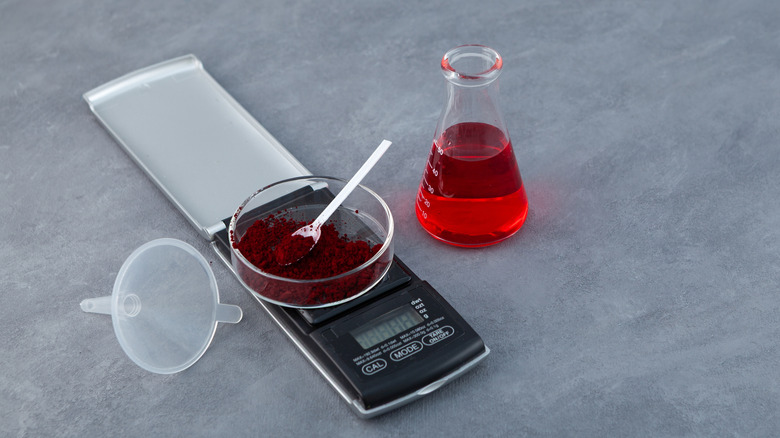
First synthesized from coal tar in a lab in 1878, red dye no. 2 (once known as amaranth) has been banned in the U.S. since 1976. Unlike naturally occurring red dyes, red dye no. 2, which was later derived from petroleum, did not alter food's flavor and it was also cheaper to produce. Nine years prior to its ban, 40% of its use was to color beverages and 30% was for candies, dessert powders, and pet food. The United States banned it based on public concern after a Russian study published in 1969 by the Moscow Institute of Nutrition found that it increased tumors in rats (per EBSCO).
The FDA could neither prove nor disprove this, so they responded to public pressure and made sure it couldn't be used in food. Public fear was so strong that the Mars candy company stopped producing red M&M's for seven years, despite never even using red dye no. 2. Today, even more food dyes are being banned. Red food dye no. 3 will be fully banned by 2027 and its cousin, red dye no. 40, is primed to take its place ... for now.
Azodicarbonamide
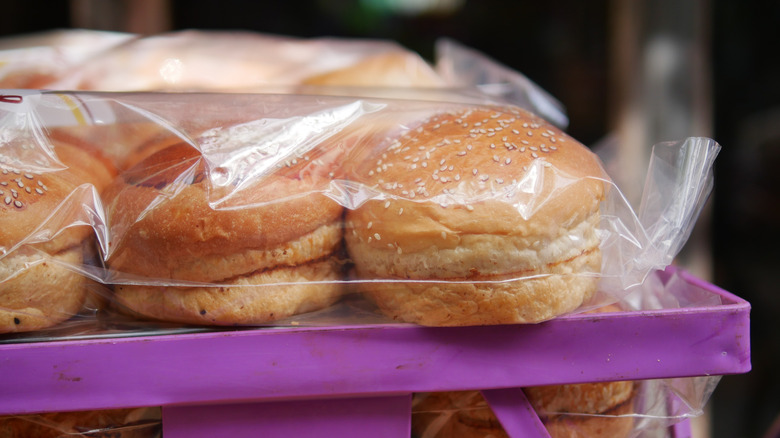
Azodicarbonamide is a bleaching agent used in flour, a dough conditioner, and a foaming agent in rubber and plastic manufacturing. "Generally recognized as safe" by the FDA since 1962, it was popular in bread products at fast food restaurants including Burger King, Chick-fil-A, Dunkin', McDonalds, Subway, and Wendy's. However, it can cause respiratory problems when inhaled and high quantities of a byproduct of it – semicarbazide, which appears as azodicarbonamide breaks down during baking — has been shown to increase tumors in female mice (per FDA).
Subway removed azodicarbonamide from its bread in 2014, despite the FDA and WHO deeming it generally safe for consumers. Refer to ingredients lists to see if other restaurants and manufacturers have removed it. You don't need to check ingredients in the E.U. and Australia, though, because azodicarbonamide has been banned for food use in those regions.
Potassium bromate

Potassium bromate, also known as bromic acid or potassium salt, was first patented in 1914 and is used as an oxidizing agent in breads to enhance gluten development, giving dough more structure so it's easier to shape. It is not a naturally-occurring compound and is also used in explosives. A study published in the Journal of the National Cancer Institute in 1983 and another in the National Library of Medicine in 1990, showed that higher amounts of orally-ingested potassium bromate causes renal, thyroid, and peritoneal tumors in rats and mice.
According to research published in the National Library of Medicine in 1986-87, it has also led to renal failure in humans. Although it's banned in other countries, it's still used in regulated form in the United States, though California banned its use in 2023.
Recombinant bovine growth hormone (rBGH), also known as recombinant bovine somatotropin (rBST)
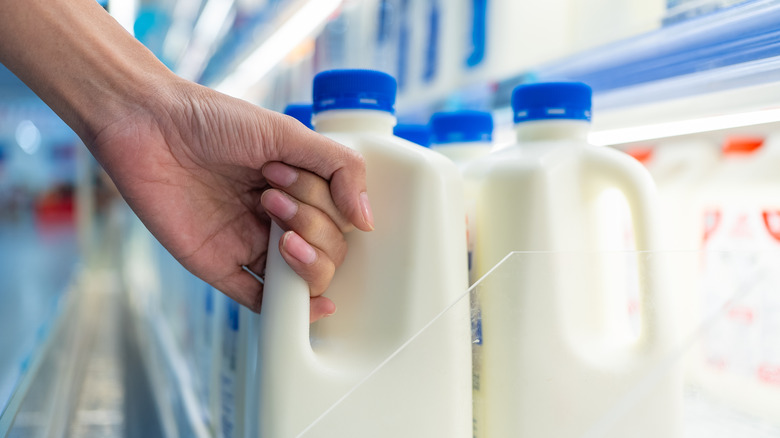
To combat food shortages during World War II, English scientists attempted to increase milk production in cattle based on research they and Russians did in the 1930s. However, this wasn't feasible large-scale until the 1980s. In 1993 the FDA signed off on dairy farmers giving cows recombinant bovine growth hormone (rBGH) and recombinant bovine somatotropin (rBST) to increase milk production, marketed under the name Posilac.
While there are no studies proving milk from cows treated with rBGH and rBST increase cancer risk, the concern lies in what the added hormones themselves produce — insulin-like growth factor (IGF-1). According to Cancer.org, early studies suggested that IGF-1 increases risk of breast, colon, prostate, lung, and other cancers; then again, later studies were inconclusive. The E.U., Canada, and other countries have banned these compounds, while the U.S. has not. Today, you may see packaging proclaiming milk to be free from rBGH and rBST.
Trans fats
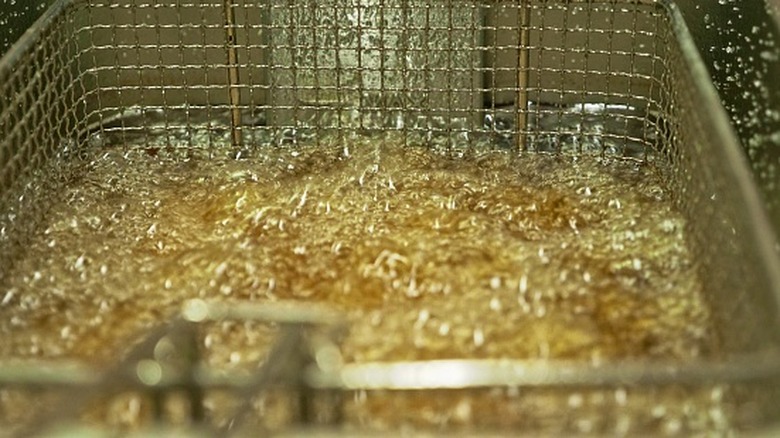
Sometimes deemed by experts to be "the worst type of fat to eat" (via Mayo Clinic), trans fats increase bad cholesterol while decreasing good cholesterol and therefore pose a significant risk to heart health. Created in the early 1900s as a cheaper and more shelf-stable alternative to animal fat, trans fat-rich partially hydrogenated oil was used in deep fryers thanks to its long shelf life and also as a supposedly healthier alternative to butter and other oils and fats in crackers, cookies, frozen pizzas, and more.
Even though studies on trans fats began in the 1970s and 1980s, it wasn't until the early 1990s that this commonly-used artificial ingredient was directly linked with heart disease. In 2006, the FDA declared that food manufacturers must label products containing trans fats. Today, municipalities like New York City and Boston have ruled that restaurants must not use partially hydrogenated oils. California has also banned it statewide.
Olestra
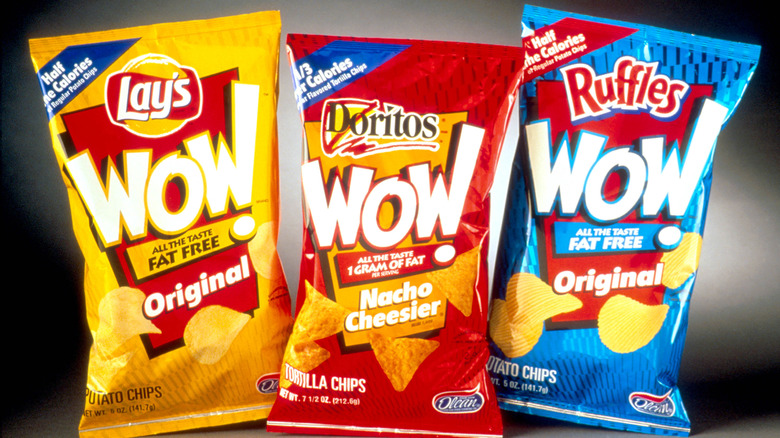
In the '90s, instead of being made with oil, chips were cooked in Olestra, a synthetic fat made from vegetable oil and sucrose that is not absorbed by your body. It therefore has zero grams of fat, zero grams of cholesterol and no calories ... and it also prevents your body from absorbing vitamins. People who ate Lay's, Pringles, and other chips also experienced a host of gastrointestinal issues, including diarrhea and severe abdominal pain. The supposed miracle substitute took 25 years and around $200 million to develop, only to be associated with these unfortunate symptoms. While the FDA hasn't banned Olestra, it's now practically never used in food products.