

Is This Retro Hack Really The Best Way To Peel Hard Boiled Eggs?
We may receive a commission on purchases made from links.
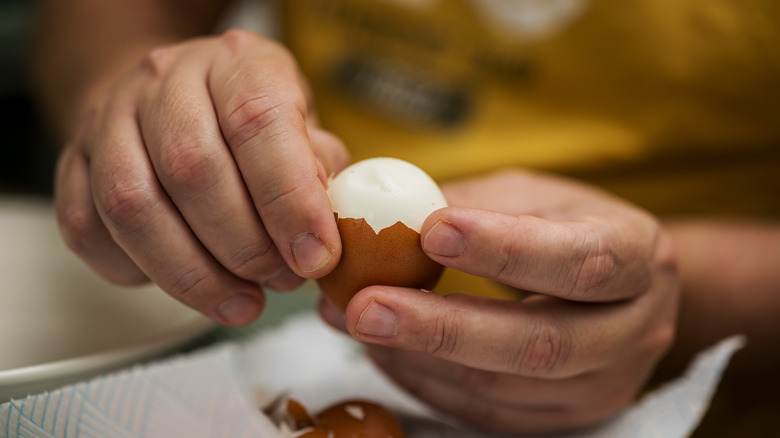
Nobody has been able to verify if the 100 pleats in a traditional chef's toque really do represent the many ways you can cook an egg, as the story goes, though there's no denying the versatility of this superfood. Flexible as it may be, hard-boiled eggs in particular can be maddeningly difficult to get right, hence the need for our foolproof cooking hack. Sadly, that's an amuse-bouche compared to the torture of cleanly peeling the little suckers. Sure, there are any number of ways to make our deviled eggs so much better, but even the biggest dollop of mayonnaise can't disguise a shoddily peeled hard-boiled egg. History, however, could have the solution: baking soda.
Adding a teaspoonful of baking soda to cold water before boiling the eggs can make them easier to peel — potentially. The origins of the retro tip are lost in time, but Harold McGee does provide it in his 1984 book, "On Food and Cooking." In it, he suggests that a dash of baking soda increases the cooking water's alkalinity, making the eggshell easier to get off. What's more, the older an egg is, the more alkaline its interior membrane becomes and the less it clings to the inside of the shell, making it easier to peel.
Plenty of people insist that adding baking soda to their cooking water worked for them, but there are seemingly almost as many who found it didn't make any difference and that leaving their eggs in the fridge for a couple of days — thus increasing their alkalinity — did just as good a job. Intriguingly, it's not the only method folks have come up with to ensure their hard-boiled eggs are smooth and pit-free.
Temperature shocks, technology, and party tricks can help cleanly peel your hard boiled eggs
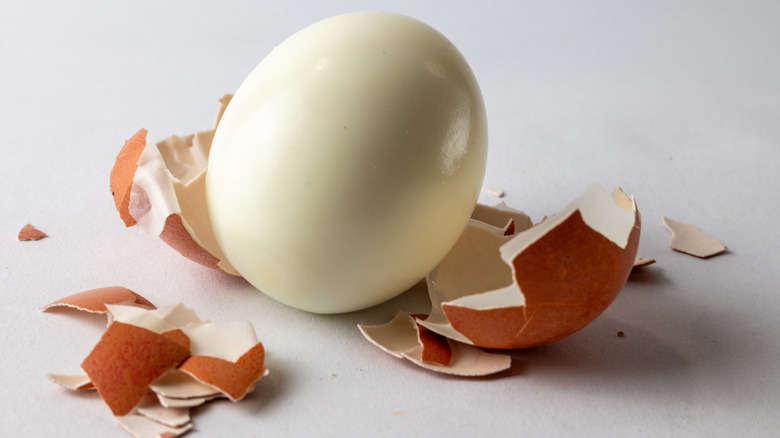
Ree Drummond saves money on groceries thanks to her simple tip, but she's one of the many advocates for a two-step method of successfully peeling hard-boiled eggs. First, they need to go in boiling — not cold — water, before the heat is reduced to a low simmer. After around 13 minutes, they're plunged into an ice bath; the shock of these temperature changes makes the membrane in the egg contract. Another hack doing the rounds online is tapping the fat end of an egg with a spoon to break the membrane before it cooks. You can clearly hear a change in the tap when it happens, and it seems to yield positive peeling results, though to be fair, this Instagram poster also used ice to cool their eggs.
Other folks peel their eggs under running water to lubricate the process (but it can be wasteful if you're watching your utility bill), while some home cooks swear that a splash of vinegar improves the peeling process. Prising the hard-boiled egg out with a spoon is a bit more unreliable, but dropping a hard-boiled egg into a clean jar or a glass and giving it a good shake is a useful hack that can make peeling a breeze, and of course, there are gadgets like this egg peeler that can do all the work for us. If you're feeling really adventurous, you could try the online party trick of blowing the eggs out of their shells. Just make sure you've got a catcher on standby, and save those eggboxes for your on-the-go grilling.