

For Weeknight Dinners In Half The Time, Try Out This Prep Tip
Food should be a wonderful journey of discovery. Exploring different ingredients, discovering new flavors, finding out which techniques get the best results; it's a world that should be lingered over and savored. Yet the reality, even for the most ardent foodies, is that life comes at us fast and cooking weeknight dinners often feels more like a sprint than a marathon. While chefs on television often have all their ingredients weighed out in separate bowls to speed things up, cooking your grains in advance and keeping them in the fridge is a practical prep tip that can easily halve the time it takes to get dinner ready.
Who among us hasn't stood in a cloud of steam in the kitchen, tearfully boiling rice that is resolutely rock-hard while everything else is slowly going cold? Prepping it in the morning eliminates all that frustration, and it's not just a tip that works for all kinds of rice. You can use it for lentils, beans, and quinoa (just remember this water-to-grain ratio for the latter). They're all ingredients that can be partially or fully cooked, either in the morning while you're getting ready for work or even earlier. If you plan your weeknight dinners ahead of time, your grains could be batch-cooked when it's convenient and stored in either individual or family-sized portions, depending on what future you will need.
Time saved prepping is great, but don't skip the reheating recommendations
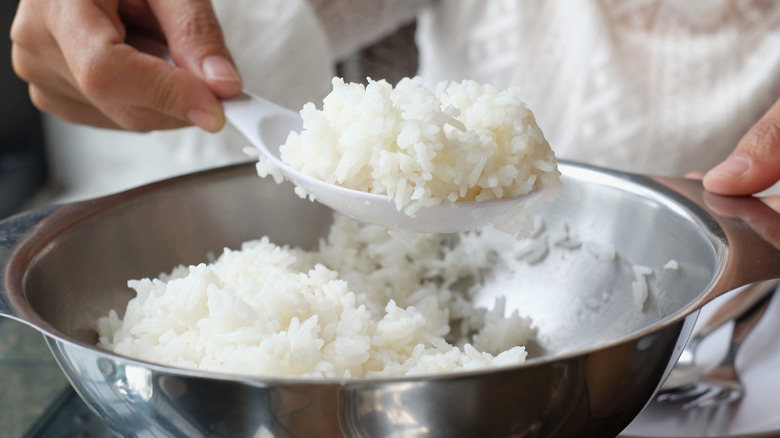
Time-wise, there are a couple of big advantages to cooking grains in advance. Do it during a quiet afternoon, for example, and you could play around with added aromatics or spices to enhance their flavor. Knowing that the necessary portions of one of dinner's key components are in the bag can also give you headspace to focus on other ingredients, or even just chew the fat with the fam while the rest of the meal comes together. All that being said, what you do with those pre-cooked grains after they're cooked is crucial, especially when it comes to safely storing and reheating cooked rice, which can play host to the illness-causing B. cereus bacteria if you're not careful.
The USDA recommends giving cooked rice two hours to cool to a temperature of 70 degrees Fahrenheit, and it must be down to at least 40 degrees Fahrenheit within four hours. To reheat cooked rice that's been stored in the fridge, give it at least five minutes on the stove or one minute on high for every cup in the microwave. Double that time to nuke your pre-cooked rice that you froze to prevent it from drying out. For other foods, such as lentils or quinoa, the USDA's advice is to make sure they reach an internal temperature of 165 degrees Fahrenheit — unless of course, you're serving them cold.