

The Powerhouse Pantry Staple To Degrease Filthy Kitchen Cabinets
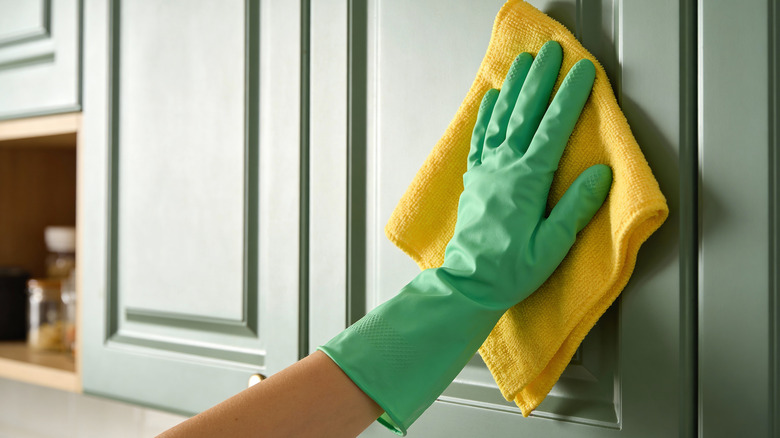
Our kitchens are places to relax, chew the fat, and cook — obviously — but they're also magnets for dirt. Everything we cook ends up in some way, shape or form, coating every surface, including our cabinets, and the worst substance of all is grease. It can be notoriously difficult to eliminate, and if you don't want to resort to harsh chemicals, vinegar can be your best friend. Many people use it to clean their dishwasher, but this natural product is ideal for keeping your kitchen cabinets grease-free and tickety-boo.
The acetic acid in vinegar is the reason it's such an effective de-greaser, whether you plump for white vinegar or an apple cider, which has a nicer smell. They will all eat through any oogy grime, killing any bacteria or mold they encounter at the same time. Vinegar is safe to use either sprayed straight from the bottle or diluted in a little water if you're worried about your kitchen cabinets' finish (more on that later). If you have some built-up grease and need a little extra oomph, there are a couple of things you can do.
Soaking kitchen paper generously in vinegar, applying it to the greasy spot and leaving it for 15-20 minutes can help break down any resistant gunk. If you need a little abrasion to get the filth off, mix it into a paste with either salt or baking soda (pantry staples that are also great for cleaning aluminum pans) and combine them with some elbow grease for a 100% natural cleaning solution. Vinegar also works well when diluted with water and a couple of drops of dish soap added to the mix, for grease that is super-tricky to shift.
Vinegar is safe to use on most kitchen cabinets as long as you're careful, but never pair it with bleach
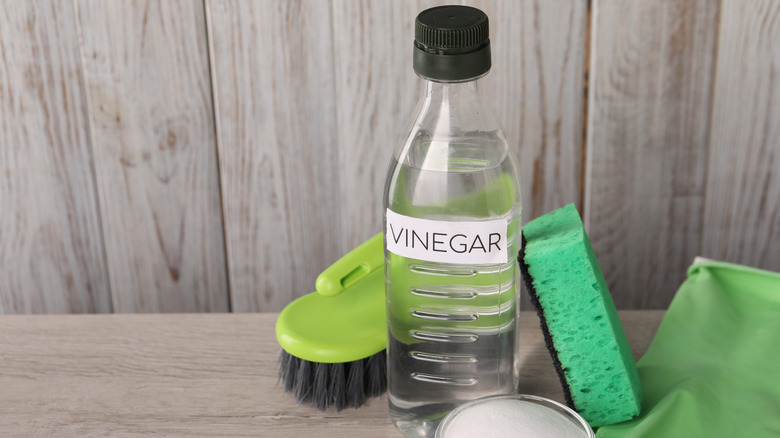
It's worth noting that, although vinegar is a natural product, by no means is it suitable for all surfaces in your kitchen. Vinegar will clean non-porous countertops like a charm, but it will knock years off the lifespan of your granite surfaces. Laminate kitchen cabinets can happily take being regularly cleaned with vinegar to keep grease at bay, as will wooden and painted doors, though it pays to dilute the vinegar and clean with a gentle touch so you don't damage them. Now, although there are several pros to using vinegar when degreasing your kitchen cabinets, there are a couple of fairly large cons too.
In my experience, I've found that even undiluted white vinegar can have a hard time degreasing cabinets, especially those near our vent hood. A spray of it can tackle a relatively new, thin film, but older grease is a much tougher prospect. After watching pastes of vinegar and baking powder plop messily onto the countertop, I've miserably resorted to abrasive creams and scrubbing pads to thoroughly clean my cabinets. It goes without saying that you should never, ever be tempted to combine vinegar with bleach, as even a tiny amount can create potentially dangerous chlorine gas. I made this mistake just once and felt nauseous for hours.
Nothing beats the smell of a freshly cleaned kitchen, but the whiff of vinegar can be off-putting for some, especially if you're using it in an enclosed space and on more than one surface. Apple cider is a little gentler on the nasal passages, but even that can still be a little much. If you want all the benefits of vinegar without the overwhelming pong, invest in a household cleaner that contains vinegar, but has a more appealing perfume.