

The Clever Reason McDonald's Happy Meals Come In A Box
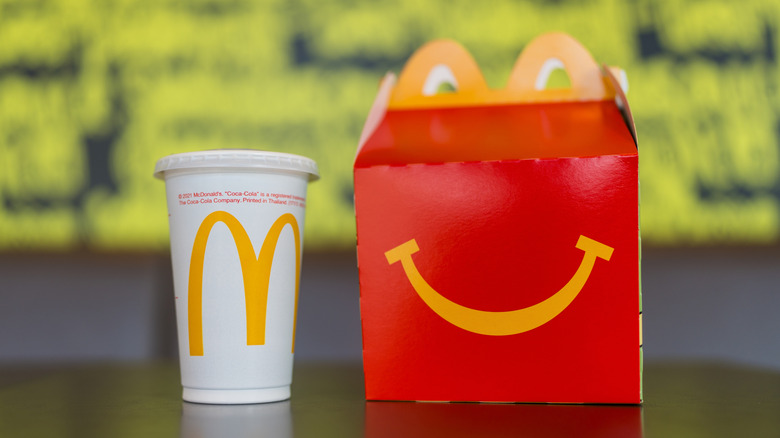
Our hunger for McDonald's lore is virtually bottomless — we know, for instance, that the restaurant didn't invent the chicken nugget and also that it's a featured fast food restaurant in the Pentagon — but we were surprised to learn the reason why, exactly, the drive-thru giant's iconic Happy Meals come in a cardboard box. After all, if you order just about anything else on the Golden Arches menu, it will be served up on a tray or in a paper bag. Why the special treatment for the McDonald's kids' meal?
The answer is both simple and kinda complicated. On the surface, a Happy Meal box is a marketing gimmick designed to appeal to kids' innate curiosity, as it was thought that children liked something cool to look at while they ate. Reportedly, the template was a cereal box. Keep in mind that, when the Happy Meal was born in 1979, there were no iPads or mobile gaming consoles to distract little 'uns at the dinner table! The first Happy Meal boxes featured circus-themed puzzles and mazes to engage the youngest McD's consumers, who, until then, had not enjoyed a dedicated option on the fast food menu.
Depending on who you ask, McDonald's Happy Meal boxes could also have been a response to competition from a rival called Burger Chef, which was able to secure lucrative marketing partnerships with film companies for real estate on its kids' meal packaging. Was the Happy Meal a response to Burger Chef's flashy Fun Meal? The truth has become muddled over time (and a lawsuit alleging trademark infringement went nowhere), leaving us with conflicting anecdotal reports.
The Happy Meal has evolved, but its spirit is intact
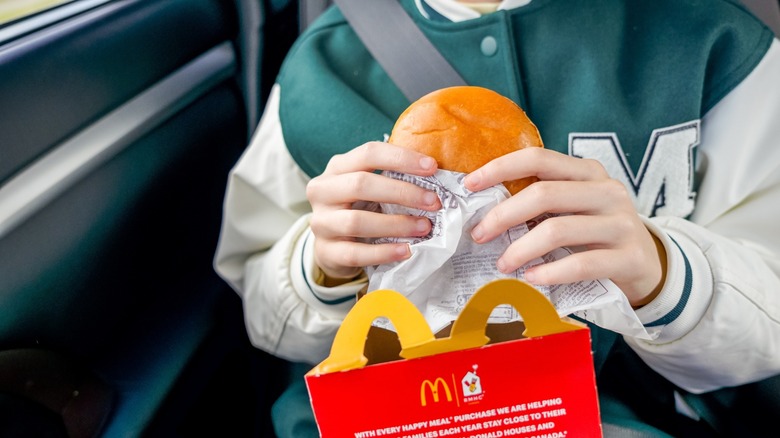
A Happy Meal cost a piddly $1.10 when it debuted in 1979 and came with a burger, fries, cookies, a small drink, and a toy. Over the ensuing decades, the Happy Meal has seen several shake-ups to the original formula. Chicken McNuggets eventually came about as an option, for one thing. The portion of fries shrank and eventually shared box space with apple slices instead of cookies, as nutritional experts drubbed McDonald's for serving kids junk food. Milk and water became default beverage options in lieu of soft drinks (which are still available if you ask).
All this, of course, is to say nothing of the toys. Hundreds of different Happy Meal promotions have cycled through the decades, featuring partnerships as illustrious as Barbie, Hot Wheels, and Beanie Babies, along with scores of contemporary movie and TV properties. Some of these Happy Meal toys are worth a small fortune today and have inspired dedicated collectors' markets.
To crib from a popular adage, however, the more things change, the more they stay the same. Even in the digital age, children are captivated by the Happy Meal. Over 1.5 billion toys are distributed through Happy Meals each year (per People + Science), making McDonald's the unlikely, yet undisputed, largest toy distributor on Earth. The Happy Meal box is a visual icon that transcends place and language. Today's kids have much more stimulating forms of entertainment to keep them busy and well-behaved at dinner, true, but the box still means something — it promises yummy food and a treat, a combination that kids adore.