

1919's First-Ever KitchenAid Mixer Looked Like A Massive Machine
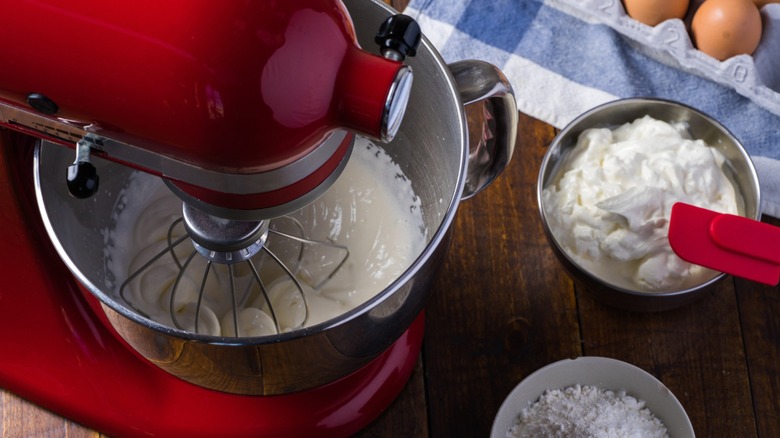
A KitchenAid stand mixer is an indubitable foodie status symbol. Its gleaming enamel exterior and stainless steel bowl have inspired countless fiancés and nascent homeowners to place it on registries with the promise of lofty cakes and crisp cookies left out on Christmas Eve. This isn't just an appliance; it's the stuff that domestic dreams are made of. Before the iconic KitchenAid mixer took its current physical form, however — which happened around the middle of the 20th century — it was an absolute unit of a machine. The first KitchenAid mixer, 1919's Model H-5 made by the Hobart Manufacturing Company, weighed a stocky 65 pounds and cost the equivalent of almost $3,000 in 2026 dollars.
Today, a KitchenAid stand mixer runs under $1,000 (with many basic models costing just half that) and, while heavy, can be easily moved by most able-bodied adults. Some consumers avoid its food processor attachment, but we remain captivated by add-ons that whisk, fold, knead, make pasta, grind meat, spiralize veggies, and make ice cream. The Model H-5 had a mighty 80-quart bowl and could also handle tons of kitchen tasks, including straining and basic cutting and slicing. In 1927, Hobart managed to scale down the Model H-5 a bit and rolled out the so-called Model G. Even with its inflated price, it briskly sold some 20,000 units. Over a century later, however, a coterie of dedicated culinary fanatics still revere the large-and-in-charge Model H-5, even though it's completely outsized for most modern kitchens.
Some social media food geeks are still using the Model H-5
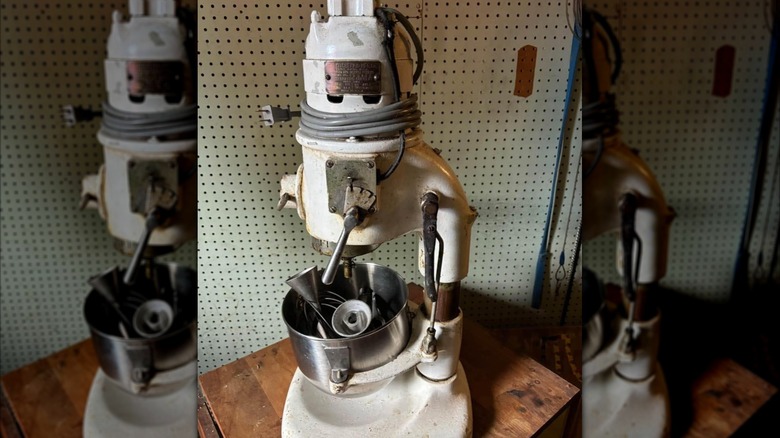
Vintage glass canning jars may raise safety questions, but a spate of original Model H-5 KitchenAid stand mixers are out there in the wild, proving that, for all intents and purposes, you just can't kill the darn things. We've seen enough of these behemoths on social media — albeit restored by skillful hands — to prove to us that KitchenAid mixers may just live up to the promise of generational use (though always check any electrical wiring, to be safe). On Reddit, a user aptly going by "MrMixer316" posted an image of a spiffy-looking restored 1919 mixer with a paddle that appears remarkably like the one attached to a modern KitchenAid appliance. Sharp eyes will notice a primitive version of the vertical lift mechanism employed in modern mixers that lack a tilting head. The off-white color is utilitarian but still looks clean and presentable. The size, admittedly, is daunting.
A Facebook user showed off a picture of their updated 1919 mixer kitted out with a bubble whisk in a kitchen that looks appropriately retro. Comments ooh'd and ahh'd over the power and beauty of the mixer, with some expressing envy. Meanwhile, on another Facebook group dedicated to repairing old KitchenAid mixers, one member sparked a discussion about the H-5 and brought up the fact that, instead of a plug for an electrical outlet, the 1919 mixer screwed into a light socket for power! Should you run into one of these old-school beauties for a good price, you might want to scoop it up (probably with a friend, since it's heavy). In yet another social media discussion, anecdotes suggested that these 100-year-old workhorses can possibly fetch prices in the thousands nowadays.