

How To Make Better Salad Dressing With The 3-To-1 Method
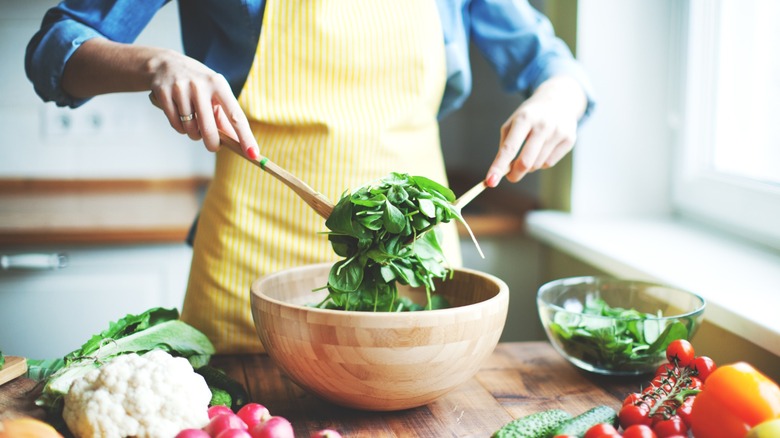
Sometimes a salad is a complex thing that draws all the attention at the dinner table — just look at the viral TikTok green goddess salad, for instance — and other times, it's an understated, lovely supporting player to a main dish. It provides freshness to the meal, but doesn't demand its name above the title on the marquee. For such a salad, you need a basic vinaigrette that's yummy but easy to prepare while you focus on your entree. We like a formula that's so simple, it's a basic ratio: three-to-one.
We covered a similar idea when we discussed celeb chef Alex Guarnaschelli's four-ingredient weeknight salad dressing, but this formulation is both simpler and more versatile. All you need to remember is three parts oil to one part vinegar, all held together with your choice of emulsifier. When whisked slowly but firmly, this fundamental vinaigrette recipe will form a stable salad dressing that not only won't separate on you but reliably produces delicious results that play well with just about every salad green out there.
As is the case with much dazzling phenomena in the culinary world, the trick behind this dressing is a matter of science. Oil and water-based liquids like vinegar repel each other, as just about everyone knows. Emulsifiers, however, contain both hydrophilic (water-loving) and hydrophobic (water-repelling) ends on their molecules. Each end binds to either oil or water, helping the two substances consequently "stick" together. Dijon mustard is a popular emulsifier for vinaigrettes, but it's not the only one in your toolbox ... or, rather, pantry and fridge.
Emulsifiers are just one way to customize your winning dressing
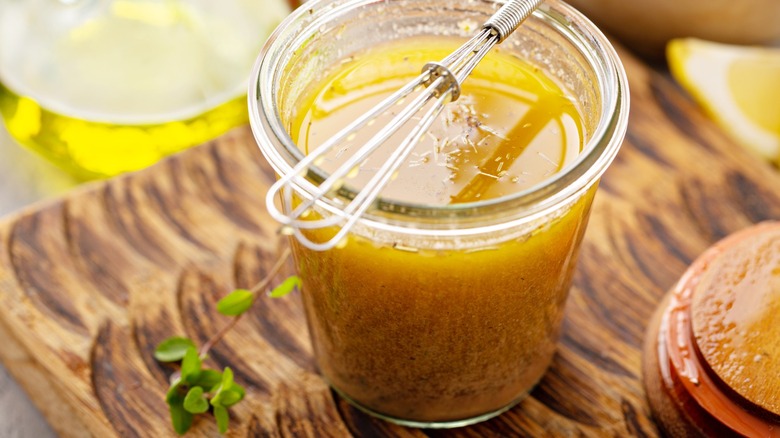
When it comes to emulsifiers, you have a lot of choices, and your option(s) will affect the taste of your finished dressing. Most forms of mustard are emulsifiers, meaning you're not restricted to Dijon. Honey mustard, yellow mustard, and spicy mustard all have their places in different iterations of a salad dressing ... heck, we even covered a dill pickle mustard at Trader Joe's when we ran down a roundup of its treats for pickle lovers. But mustard is not the only answer! Honey, egg yolk, mayo, and tomato paste are all culinary emulsifiers that might just suit your unique salad dressing. Egg yolk, of course, is one of the most neutral options. You've heard that eating raw yolks is capital-B Bad, and with good reason — potential salmonella is no joke. Pasteurized eggs, however, are safe to eat raw and are probably available at your supermarket.
Don't forget that choosing an emulsifier is only part of the equation when customizing your easy, perfectly homogenous salad dressing. Will you add in aromatics like minced onion or shallot for sharpness and that delicious "salad-y" smell? Speaking of luscious aromas, how about some fresh herbs? If you opt for a vinaigrette with red wine vinegar and tomato paste, it will practically stand up and beg for a dash of basil and oregano to dress your greens. And, of course, you can't possibly omit the salt and pepper. Frankly, too many folks overlook these basic hallmarks of seasoning, and their (bland) salads suffer for it. Remember, your 3:1 vinaigrette is meant to be easy, but stands to definitely be long on flavor.