

The First-Ever Slow Cookers Were Made In The 1940s – Here's What It Was Like To Use One
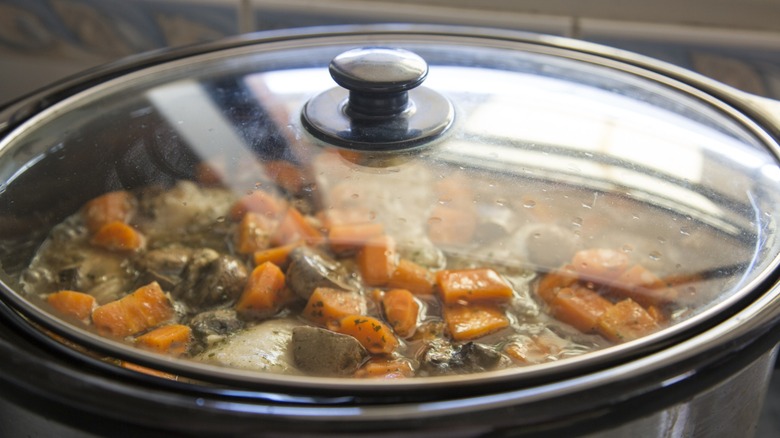
The slow cooker sitting in your pantry, that steady, faithful companion for dishing up beef cheeks (an underrated cut of meat) or baking canned cinnamon rolls — to say nothing of countless stews, soups, and casseroles — has been around in some form for nigh on 90 years. You may not have known that this device, a must-have for cooks short on time and longing for hearty but low-effort dinners, had its roots in Lithuania, where observant Jewish cooks used history's first slow-cookers in an attempt to keep Sabbath rules. Growing up in New Jersey in the first years of the 20th century, Irving Nachumsohn heard from relatives how family members used to take their prepared pots of an uncooked stew called cholent to the town bakery on Friday nights, where the cooling ovens would passively heat the crocks overnight and uphold the Sabbath law against turning on the home oven.
In 1940, Nachumsohn's company, the Naxon Utilities Corp., received a patent for a device that would enable countertop cooking on hot days when turning the oven on was undesirable for reasons of heat and not necessarily faith. By the 1950s, the "Naxon Beanery" was a hit — and Nachumsohn had changed his last name to match that of his company, following anti-German public sentiment after World War II. The Naxon slow cooker, which simply plugged in and lacked control dials or even an on/off switch, was intended primarily as a bean pot meant to circumvent the long simmering required for cooking dried beans on the stove or in the oven. Like today's slow cookers, the appliance contained a crock inside a casing with a heating element to ensure that the contents (beans or otherwise) heated evenly.
How the slow cooker became the Crock-Pot and entered the modern era
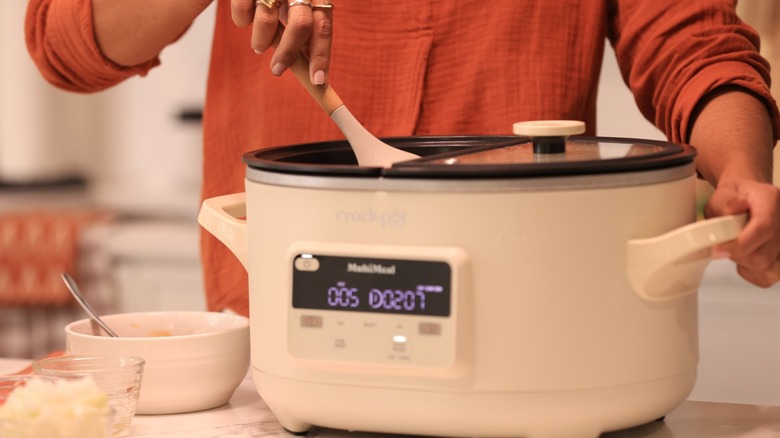
Today, many home cooks use the terms "slow cooker" and "Crock-Pot" interchangeably, but that's not exactly accurate. A Crock-Pot is a brand name for a certain slow cooker — specifically, the slow cooker made by Rival, which purchased Naxon Utilities in 1970 when Irving retired. Today, you might see "Crock-Pot" used for any slow cooker, a process called genericization that has happened in a similar way to Velcro and zippers (both originally trademarked brand names). No matter what you call it, however, today's slow cookers would likely amaze Irving Nachumsohn, a consummate inventor who, by all accounts, loved innovation.
In the 2020s, you can cook two meals side by side in a "smart" slow cooker with multiple functions. Slow cooker overnight safety guidance says that you can use these appliances unattended — they work on low wattage — and are probably a lot safer than the vintage models that still command a high price on resale sites. They also aren't likely to cause fires, despite popular myths arising from dramatized TV show plots.
The slow cooker might be a home cook's closest thing to a perfect solution for the stress and inconvenience of daily cooking, the rare holdover from the early 20th century that still works beautifully today. The next time you throw dinner in the Crock-Pot, send up a silent prayer of thanks to Irving Nachumsohn and, before him, the ingenious Jewish home cooks of Lithuania who were just trying to whip up a hot meal while observing religious mandates.