

What's The Best-Selling Beer Company In The World?
When a beer company is such a behemoth that it can stake a claim to a full quarter of all global beer production, you know you're dealing with a heavy hitter. The mega-corporation that runs the show when it comes to the bestselling beers in the world is Belgium's AB InBev, an entity that, in 2008, absorbed the industry monster Anheuser-Busch (hence the "AB"). In 2016, the company followed that up with the massive acquisition of SABMiller. The story of AB InBev is one of steady growth that stretches back hundreds of years. According to the 2024/2025 BarthHaas report, AB InBev produced over twice the amount of brewski output as its closest competitor, Heineken of the Netherlands.
If you enjoy beer, odds are that there's at least one AB InBev product that you have consumed in recent memory. Its stable of brands encompasses more than 500 labels and includes the total list we'd already compiled of beers you didn't know were owned by Anheuser-Busch. You'll see Michelob ULTRA, currently the best-selling beer in the U.S., as well as Budweiser, Corona, and Stella Artois on the list, to name just a few. How much beer, exactly, does it take to slurp up 26.4% of the world's production? That would be 13.1 billion gallons in 2024 alone, the most recent year for which there were numbers available at the time of this writing.
History and sheer size account for AB InBev's success
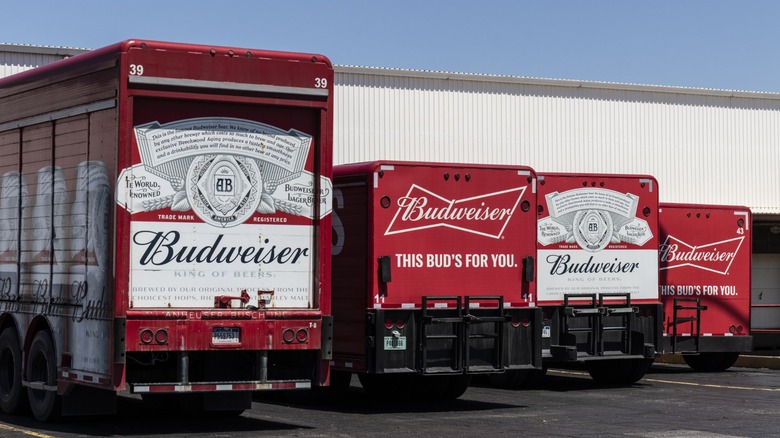
The oldest beer company in the AB InBev stable, Leffe, was first brewed in a Belgian abbey in 1240. Nor is that an outlier when it comes to longevity, as both Stella Artois and Spaten, two other AB InBev subsidiaries, came into existence in the 14th century. The United States was a relative latecomer to the game, not appearing in the chronicle until 1876, when Adolphus Busch first helped brew Budweiser beer at the flagship Anheuser-Busch brewery. AB InBev's portfolio now contains 21 distinct billion-dollar brands. More numbers, you ask? There are 170 breweries around the world belonging to the corporation, which also employs 144,000 people globally (via AB InBev).
As we've intimated, AB InBev didn't become as big and productive as it currently is out of nowhere — one doesn't brew double-digit billions of beer as an overnight sensation, after all. Its story is one of growth and acquisition, with the proverbial rolling stone gaining in size and power as it absorbed smaller local and international companies over decades. In the same way that Anheuser-Busch dominated Super Bowl ads for years, so has the goliath purposely pursued growth in the last 100 years. Next time you go to the liquor store, scan the beer section for all the AB InBev names you recognize. We predict you'll be bowled over by the retail space they take up.