

Not Hummus Or Yogurt: Boomers Should Eat This Snack To Boost Muscle Performance

Millions of Americans have grown up on PB&J sandwiches, carrying them to school in a paper bag for lunch, or enjoying them, like Bruce Springsteen, as a late-night snack. But while some boomers have ditched peanut butter in favor of healthier foods, such as hummus or yogurt, as they got older, science suggests that might have been the wrong move. A study, carried out by researchers at the Institute for Physical Activity and Nutrition at Australia's Deakin University, found that eating 43 grams of peanut butter per day helped people aged 66 to 89 to increase their muscle power and muscle protein, without expanding their waistlines (per the Journal of Cachexia, Sarcopenia and Muscle).
At the end of the six month study, those who had been taking the generous tablespoon of peanut butter did a five-time, sit-to-stand test faster than a group who had not been given the PB. Lead researcher on the study, Associate Professor Sze-Yen Tan, explained the results, saying: "Peanut butter is a naturally rich source of nutrients such as protein, healthy fats and antioxidants that reduce inflammation and muscle breakdown," (via Deakin University).
The next time you're making PB&Js, remember to set a sandwich aside just for you. Or rustle up some of your own peanut sauce to slather over chicken, or make that long put-off batch of peanut cookies, safe in the knowledge that the key ingredient in all three could be doing your muscles the world of good.
PB can be easier for older people to eat, but it's not the only nut butter they can try
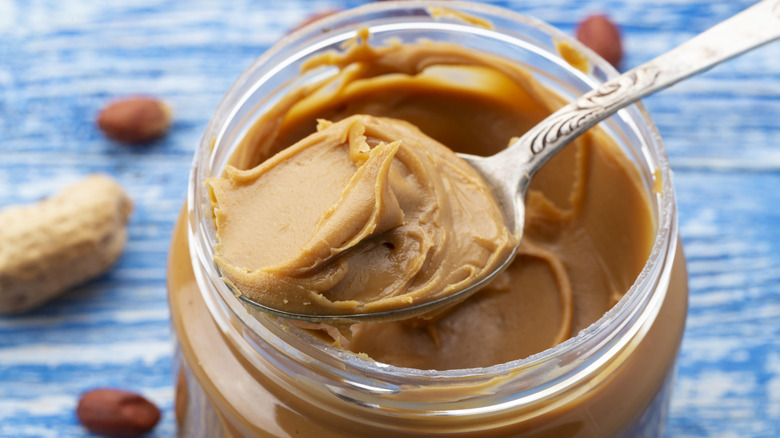
The study is good news for anyone looking for a tasty way to boost their muscle performance as they get older. While moderation is key, a daily spoon of peanut butter also provides a host of vitamins and minerals, such as magnesium and vitamin E, just two of several nutrients that are important for older adults. There are other advantages too.
Slurping down a spoonful of smooth spread can be easier for seniors to handle and swallow than peanuts themselves, while a jar of PB might be cheaper than an array of over-the-counter supplements. Having said that, there are a lot of unhealthy peanut butter brands out there, so it's important to read the ingredients labels on jars, especially if you or someone you know is watching their salt and/or sugar intake. The spread used in the study was store-bought, it was natural peanut butter containing "minimal" extra sugar.
But what if the boomer in your life isn't a fan of peanut butter? That's easy: there are lots of other nuts and nut butters out there that can do just as good a job for their muscles. Almonds and pistachios are good sources of the protein that can fortify muscle, the copper in hazelnuts helps their growth, and the selenium in a single Brazil nut can boost your muscles too.