

The Watering System You Need For The Healthiest Tomato Plants This Year
We may receive a commission on purchases made from links.
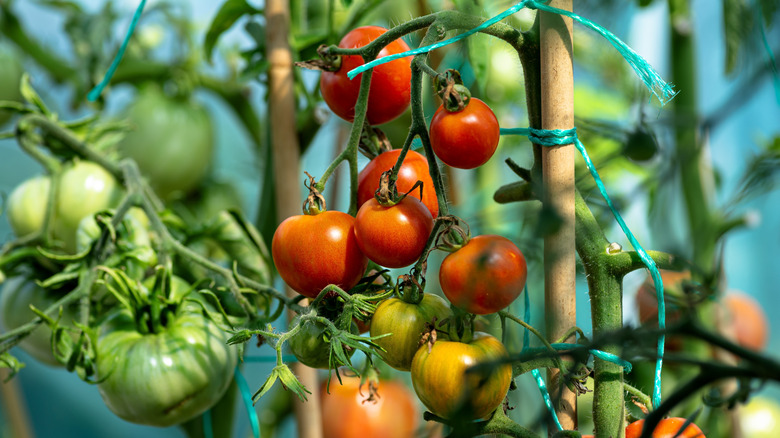
On the long list of fun facts you didn't know about tomatoes, you won't find the fact that tomatoes are surprisingly tricky to grow — and, yet, it seems to be true. Despite that 66% of all Americans with a garden in 2023 were planting tomatoes (as per Ruby Home), making them far and away the most popular veggie in the States, folks seem more than a bit bedeviled by these crops. Social media posts are full of home gardeners bemoaning the fact that their tomato plants are beset by yellowing leaves, beetles, rot, and/or bad fruit. We can't solve all your tomato problems, but we might just have the answer for watering them.
When it comes to watering tomatoes, soaker hoses are the way to go. A soaker hose is a permeable hose that, instead of spraying water out of one end, continually drips water from its pores. Laying one of these hoses along the bases of your tomato plants accomplishes a few aims. First of all, it ensures deep, thorough watering ... an absolute must for tomatoes (more on that in a bit). Secondly, it isolates said watering to the roots. You definitely don't want water or soil to splash up on the leaves of your tomato plants, because this is a great way to introduce diseases. Lastly, a soaker hose is not only more effective than watering by hand, but much less time-consuming as well. All you need to do is run one or more soaker hoses down the length of your tomato plants. You don't want it too long — a 50-foot hose, like this well-rated one by Hlinker, will ensure that all plants along its length receive equal amounts of water.
Here's how (and why) you can effectively water with a soaker hose
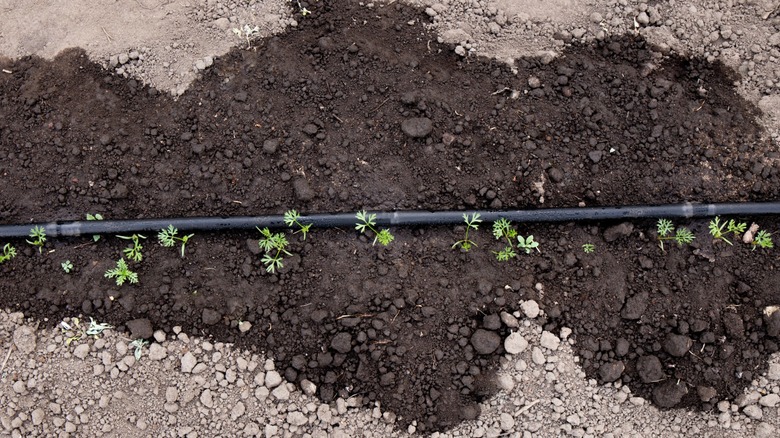
When it comes to homegrown tomatoes, the right amount of water in the right place is everything. The answer to why tomatoes crack is irregular watering, after all. Consistent, deep watering makes tomato plants happy — and some extended (around 30 minutes) sessions with the soaker hose twice a week, barring any extra rainfall, should go far towards ensuring that happiness. For extra moisture retention, lay down your soaker hoses after you place your tomato cages (since the cages can pierce the hoses accidentally) and cover them lightly with mulch to trap the water seeping into the soil.
For the most effective watering with soaker hoses, you want to ensure that your water pressure is just right. Too much pressure, and your plants will get over-saturated, which is just as bad as letting them dry out. Too little pressure, and the water will never make it to the end of the hose, which places your plants further from the spigot in jeopardy. If your water pressure is good, consider purchasing an inexpensive, easy-to-use hose splitter fixture that divides the stream between two hoses. You may want to run at least two hoses, anyway — one on either side of your plants. The hoses are flexible and can be curved or circled as needed. If you have multiple soaker hoses in your garden, you'll just have to take the time to switch which one or ones are attached to your water source at any given time, giving all plants their respective turns.