

The Breakfast Superfood With Nearly As Many Omega-3s As Salmon
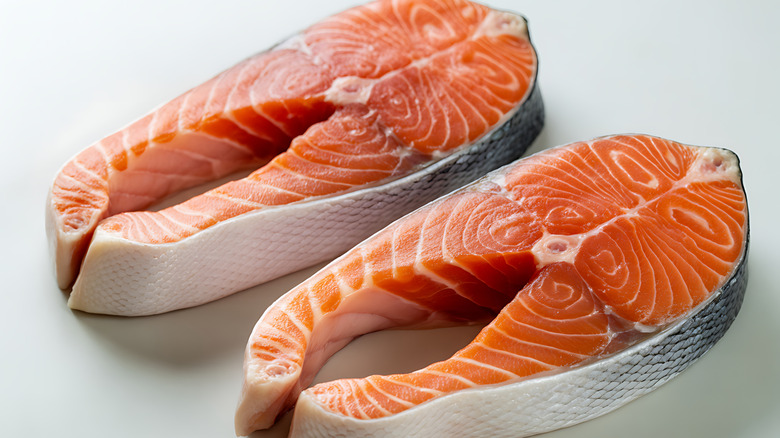
Unless you live in coastal regions, chances are you're among those people who don't eat enough seafood. As well as being a tasty alternative to meat proteins, fish — particularly salmon — is a good source of omega-3 fatty acids, which have all kinds of health benefits. But if salmon doesn't float your flavor boat, the breakfast staple of chia seeds can help pick up the omega-3 slack.
These grains are full of fiber, magnesium, and calcium and are among foods often described as "complete" proteins. Like salmon, chia seeds have anti-inflammatory properties, but they're also good for our digestive and heart health (more on that in a minute), and they contain antioxidants to protect against cell damage. They're also a good source of omega-3, but in a different way compared to salmon.
Omega-3 fatty acids, which are different from omega-6, come in three kinds: DHA and EPA (abundant in fish like salmon) and alpha-linolenic acid, or ALA, found in plant-based sources like chia seeds. Research suggests our bodies don't convert much ALA into DHA or EPA, but scientists have also concluded that eating more ALA-rich foods can reduce the risk of heart disease (via The American Journal of Clinical Nutrition). What chia seeds may lack in DHA and EPA, they make up for in ALA, with more than 5 grams per ounce. That's more than the 1.83 grams and 1.57 grams of combined DHA and EPA in farmed and wild salmon, respectively!
Chia seeds are great in puddings but you can add them to savory dishes too
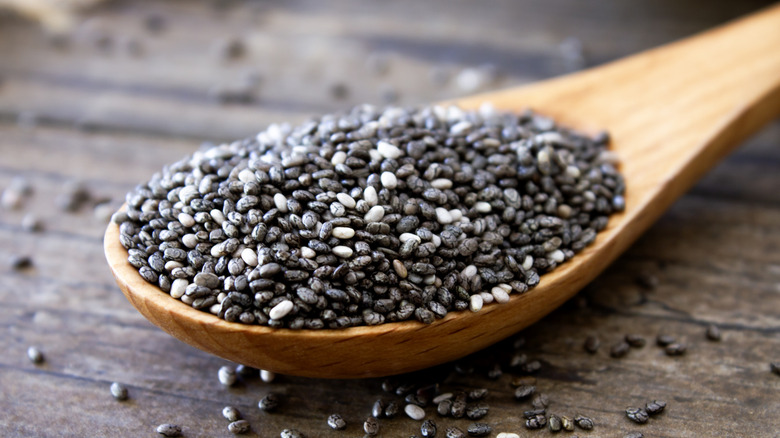
My hunger stays locked up 'til lunchtime because of the chia seeds in my morning oats. They swell up in the milk and Greek yogurt, releasing a transparent, gel-like substance that's actually a type of soluble fiber called mucilage. Left to its own devices, the mucilage would hydrate the seed, allowing it to germinate. But when we eat liquid-soaked chia seeds, they fill our tummies, so we don't feel the need to snack. Don't be tempted to swallow dry chia seeds, as they can expand by up to 10 times in moisture (including that in your throat or stomach) in as little time as 10 to 15 minutes. Pre-soak or cook with them instead!
The simplest way to incorporate chia seeds into your menu is by stirring a spoonful into water, but they're also great in yogurts and hot or cold milk-based desserts – rice pudding is a particular hit in our house. Of course, you can also supercharge a daily bowl of oatmeal with them, or toss some into a breakfast smoothie. And don't put them back in the pantry just yet — they're also a great thickener for savory sauces.
I've added them to every kind of home-made soup you can think of, as well as spaghetti sauces and my oven-baked creamed spinach. As well as helping to bulk out these dishes, the seeds' extra nutrients were snuck in right under the kids' noses. Many vegan cooks also use chia seeds as an egg substitute for baking purposes, and if you let them sprout, you'll get delicious microgreens perfect for a summer salad.