

Why Your Homegrown Strawberries Are Small (And How To Help Them Grow Bigger)
We may receive a commission on purchases made from links.
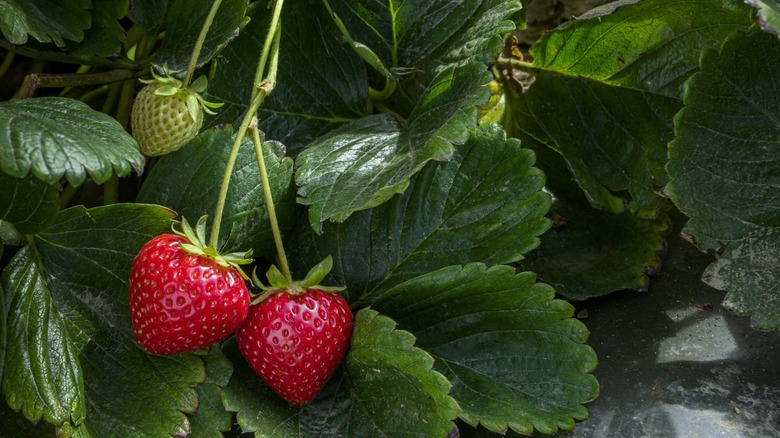
Juicy, red, and plump, strawberries are among the prettiest and most delicious fruits in your garden. That's why it's concerning to see your well-tended plants putting out puny fruit. What gives? Well, if your strawberry plants are fruiting, but not at the size that you'd like, insufficient watering is likely the culprit. Strawberries have very shallow root systems, with most of them contained in the topmost six inches of soil, and they're exquisitely sensitive to fluctuations in watering. If the weather has been especially dry or you have been remiss in irrigating the soil, you might be seeing small fruit as a result.
You might have heard of the "dry farming" tomato watering tip in which the plant is deliberately watered less to produce more flavorful fruit (it can also help you grow spicier peppers). That is not a tactic to take with strawberries, as they won't grow to their max potential without generous watering. Once you refresh them over an extended period, they will produce bigger fruit. Be careful not to go overboard and compensate with too much water, as that same sensitivity extends to overwatering, and could result in root death and/or disease.
The right plant food will also help produce bigger strawberries
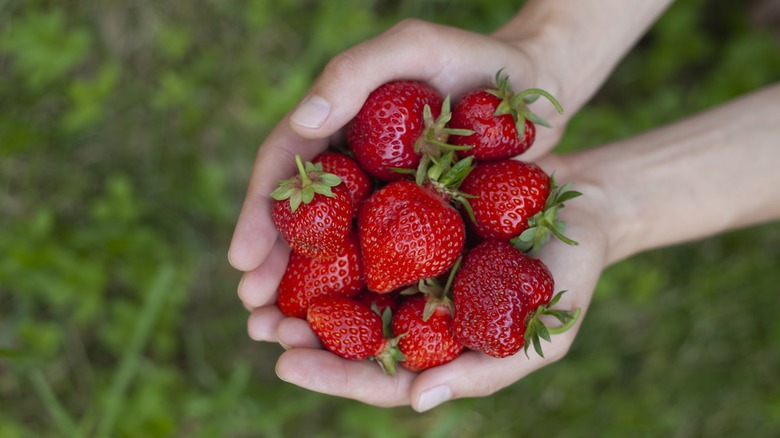
Knowing the right fertilizer balance for healthy strawberries is another great tip for a yield of bigger fruit. A balanced fertilizer with equal amounts of the "big three" (nitrogen, phosphorus, potassium) is recommended by experts for the best strawberry haul. Interestingly, however, social media users seem to swear that lower nitrogen formulas are better for these berries. "I'm dual purposing my Tomato Tone for strawberries since it's higher in the phosphorus and potassium than nitrogen, for flowering/fruiting," one Facebook user reported.
A Reddit commenter seemed to echo the sentiment: "Sometimes finding 0 nitrogen fertilizer is difficult. A 5-50-30 or similar is acceptable [for strawberries]. Plants will actually use a trace amount of nitrogen while blooming or producing fruit. The ratio is more important." It's worth noting that Amazon's top choice for "strawberry fertilizer," the highly-rated Farmer's Secret Fruit & Bloom Booster, is a 2-15-15 formula that's low on nitrogen.
The smartest bet, of course, is to speak with an expert that knows about growing conditions in your particular zone and geographic area. The staff at a local nursery may have the most relevant information on how you should be feeding your strawberry plants for effective growth ... and they may also have some helpful hints about watering frequency given your specific moisture/sun levels. Strawberry advice will be quite different in Florida than in New England, for instance! With a little TLC, you will be producing huge, delicious strawberries all season long. Here's the right way to store strawberries for your upcoming abundance!